
The Santa Maria
Most people know that the ship “Santa Maria” or La Santa María de la Inmaculada Concepción was the flagship of Christopher Columbus’ journey to the Americas. However, people may not realize that there is very little historical evidence regarding exactly what the “Santa Maria” looked like, or how it was built. There was little to no documentation regarding ship building in 1492, and this ship was scuttled and its lumber used for shelter not long after its initial voyage.
Interest in reconstructing the Santa María started in the 1890s for the 400th anniversary of Columbus’s voyage. In an effort to reproduce history, the “Santa Maria” has suffered three major Spanish versions, the first timed with the 400th centennial anniversary of Columbus landing in the New World, the second, for the Expo Iboamerica of 1929 and the last, the New York World Fair, 1964
In 1892 the naval historian, Fernandez Duro, modelled the ship as a Nao – A carrack or nau was a three- or four-masted sailing ship developed in 15th century Western Europe for use in the Atlantic Ocean. It had a high rounded stern with large aftcastle, forecastle and bowsprit at the stem. It was first used by the Portuguese (its creators), and later by the Spanish, to explore and map the world. It was usually square-rigged on the foremast and mainmast and lateen-rigged on the mizzenmast. Unfortunately, Fernandez Duro made a fundamental error as result of an erroneous reading of Columbus’s log. It was also criticised as being too ornamented for the period.
The second attempt to recreate the ship was by Julio Guillen Tato, known as the Guillen version. This reproduction for the Expo was controversially designed as a Caravel – a small, highly maneuverable ship developed in the 15th century by the Portuguese to explore along the West African coast and into the Atlantic Ocean. Caravels were much used by the Portuguese for the oceanic exploration voyages during the 15th and 16th centuries. Tato’s reproduction sailed badly and ended up a wreck.
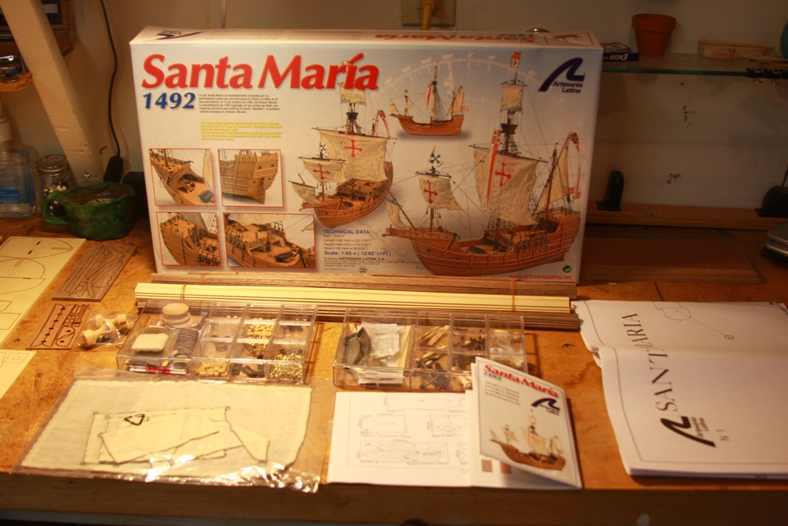
Director of the Maritime Museum of Barcelona, Spain, Martinez-Hidalgo returned the “Santa Maria” into her rightful class, as a Nao. He further refined his ideas for the 500th centennial celebration in 1992. The model I am building is from a kit by the company Atesania Latina, and will be based on this 1992 version which is considered by most ship historians to be the most accurate.

 The Lehman Shipyard