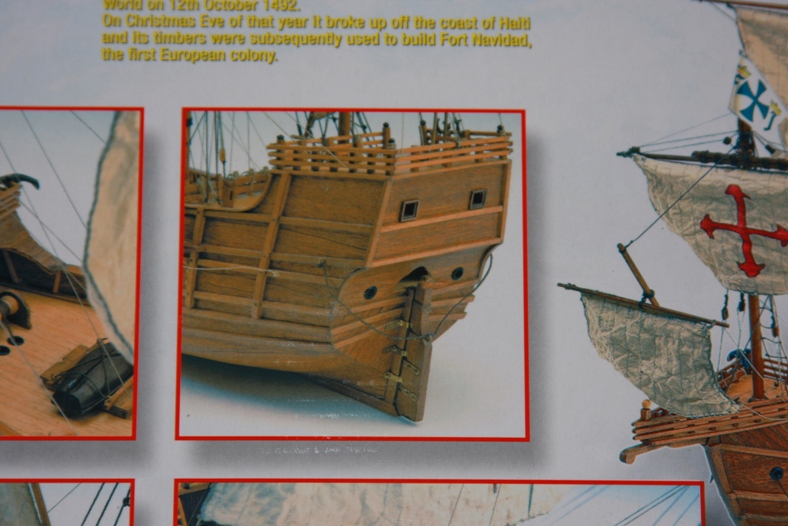
This particular kit shows the Santa Maria as having a “square tuck stern” …
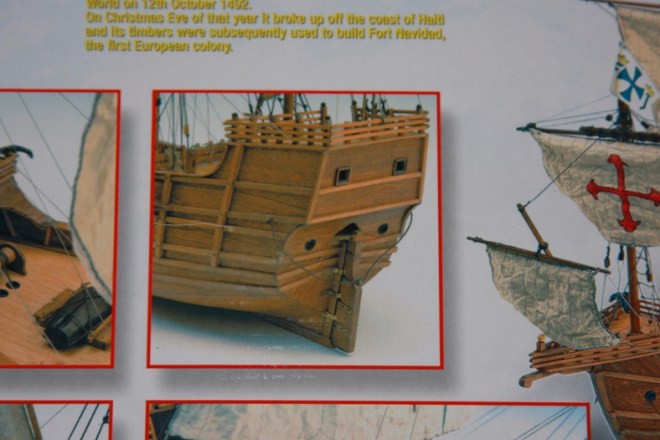
…where the hull ends in what is essentially a 90 degree angle and is flat at it’s rear where the rudder is. However, according to most Spanish ship history documentation, this style of stern didn’t hit the seas until the transition to the “Galleon” style vessel in the early 1500’s. That would have been 10 to 20 years after Columbus’ voyage.

Ships prior to the turn of the 16th century were built with a rounded tuck stern as seen in this image. Instead of ending abruptly, the hull sweeps up toward the galley, the keel, and the rudder. It is more likely that the Santa Mariawould have been built with this style of stern. Therefore, my first step toward this build will be to modify convert the stern from a square tuck to a round tuck.
The keel runs through the center of the ship and serves as what is essentially the main beam through the vessel. The “bulkeads” stem out from the keel and provide the framing for the ship. Later, the planking will be attached to these bulkeads and will form the hull of the ship. Step one is to shave off the 90 degree angle of the keel itself.
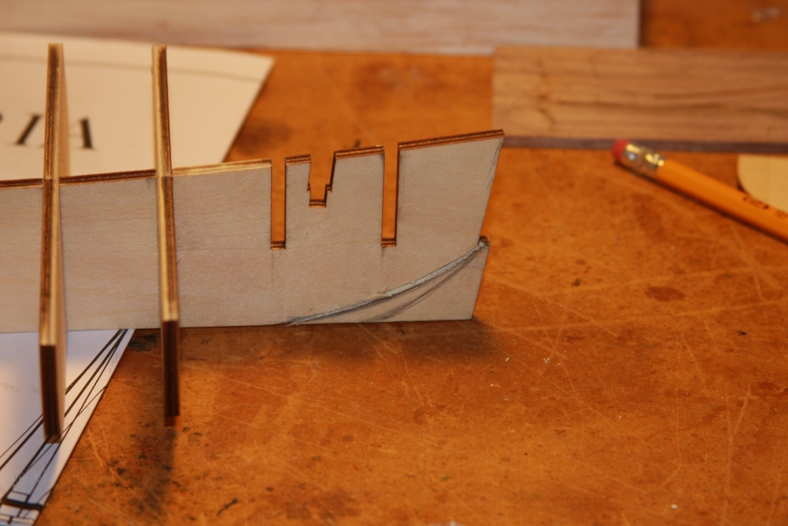

Then, the aft bulkheads need to be shaved down to accomodate the curve that occurs rather than the abrupt change of the square tuck. In this case I had to shave approximately 4 mm from each side of the aft bulkhead.
Later, when the hull is planked, each piece of the hull will need to be steamed and bent to complete the “sweep” toward the keel. To help ease that process, I filled in the stern with balsa wood.

Then I began shaving down the balsa to the desired angle and curve needed to round out the stern. After getting the starboard side the way I wanted it, I created a paper template that I could attach so I could mirror the port side as closely as possible.


The next set of steps will be to align the keel and make sure all the bulkheads are square.
 The Lehman Shipyard