
The keel and bulkeads are the “bones” of the ship and provided the base for the deck and hull planking. Therefore, making sure the keel is perfectly straight, and that the bulkeads are aligned properly is essential to the entire rest of the build. If the bulkheads ore misaligned, even by a tiny margin, the deck can end up crooked or “bumpy” and the hull planking can end up sloppy.
In Frank Mastini’s book Ship Modeling Simplified he describes a method of aligning the keel and bulkeads by using a false deck as a guide. I adjusted this method and used it as the basis for steps I took to align the deck, keel, and bulkheads.
First, I measured the exact distance between all of the bulkhead “slots” in the keel.
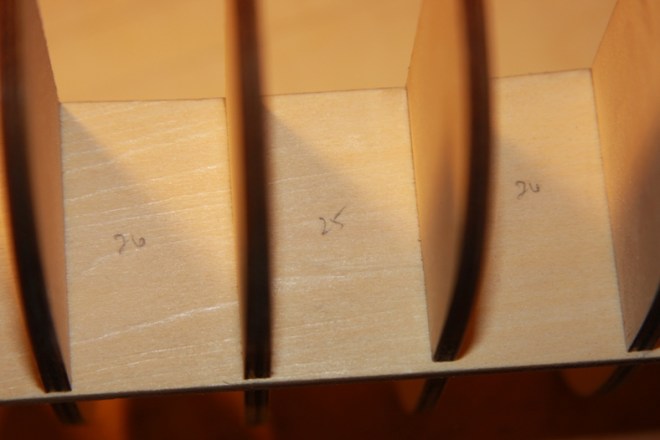
I then took those distances (in millimeters) and translated them to the false deck. I drew guidelines along the false deck indicating where these bulkheads will fall if properly aligned. This provides a template to nail down the false deck to the bulkheads without “missing”.

I tacked down the false deck along the centerline first, then aligned the end of each bulkhead to make sure it was exactly where it belonged, and nailed them down as well.

I pre-cut small blocks of wood to butt up against the bulkheads and the keel and to brace the ship and provide extra support for the hull.
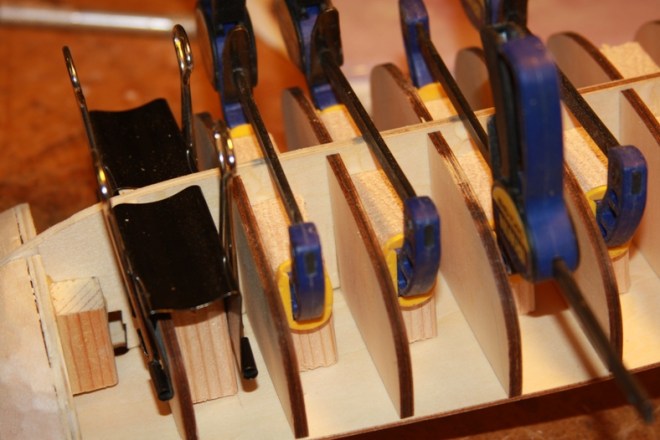
Once the glue dries, the keel should be perfectly straight with each bulkhead perpendicular to the centerline. I’ll then take the false deck off, do some sanding, then replace it permanenly.
 The Lehman Shipyard