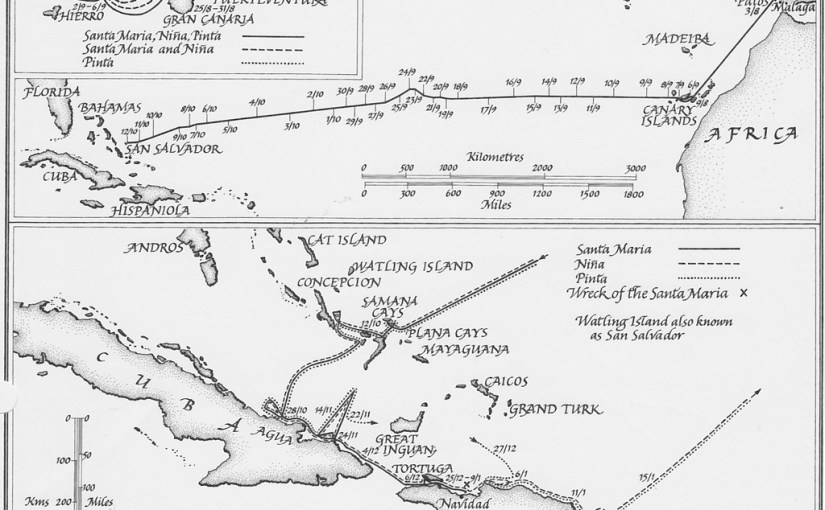
While continuing both the process of planking the hull, as well as working with the foredeck I will take this opportunity to post a little history of the voyage based on Columbus’ ship log. Most of this information is general knowledge of course, but worth repeating in this context.
Out of the three ships in Columbus’ employ, the La Santa María de la Inmaculada Concepción (The Saint Mary of the Immaculate Conception) was by far his least favorite. Both the Pinta and Nina were Caravels, light and fast. While on the other hand, the Santa Maria was a Nao, more suited to hauling cargo and was short, fat, and slow. The Santa Maria was acquired (some say last minute) from Juan de la Cosa and only used as Columbus’ flagship because it was by far the largest of the three vessels. She had a crew of about 50 men, as opposed to the approximately 18 crewmembers aboard the Pinta and Nina.

Christopher Columbus and his trio of ships sailed from the port of Palos, Huelva in Southern Spain on August 2nd following the coast of Spain then headed out to sea on August 3rd. The voyage got off to an auspicious start when the Pinta was damaged and sought repairs to her rudder at the Canary Islands. After a brief separation, the three vessels continued away from the Canaries across the Atlantic Ocean.
Although Columbus was the first European navigator to cross this region of the Atlantic, his perception of where he was, and where he actually was began to deviate in September of 1492. After travelling about 2400 miles (at an average of 4 knots), Columbus was under the impression he was in the waters of Cipango, what is now known as Japan.
The miscalculations where believed to have occurred in part due to both the difficult conditions and slow headway, as well as magnetic deviations in the ships needle. In any event, the fleet saw little progress travelling into adverse trade winds which wore on the morale of the crew.
According to Columbus’ logs, on Saturday, September 20th 1492 the crew members saw a sea bird which rarely flies very far from a coast. Eleven days later, four more birds were seen together, and in another two days a flock of more than 40 birds was spotted. Amid growing fears by the crew spurred from the fact that they’d seen birds but no land, the crew began regularly seeing both birds and vegetation on October 11th. After seeing a light in the darkness Columbus wrote in his log “It was like a little candle which rose and fell,” which is the first acknowledged sighting and description of the New World. Then, on October 12th, at 2:00 am, a crewmember named Juan Rodriguez Bermejo spotted land. That land was the coast of San Salvador, at the time called Guanahani by its inhabitants.

On October 14th, 1492, Columbus and the Captains of the Nina and Pinta(two brothers named Martin and Vincente Pinzon) landed on the beach carrying the expedition’s green cross flag and took possession of the land in the name of the King and Queen of Spain.
After a number of short voyages between the islands and becoming separated from the Pinta, the Nina and Santa Maria crossed the Windward Passage to Hispaniolia. When the local Indians informed Columbus that there was gold in Tortuga and Cibao island, he headed that way thinking he had found his promise land. However at midnight, the night December 24th and morning of December 25th, 1492, while coasting in calm waters, the helm of the Santa Maria was taken by a young ship’s boy who ran her aground on the coral reefs of the islands splitting the hull.
Notes taken from Columbus’ log book and Written by Ferdinand Colon (Columbus’ son):
“It pleased Our Lord that at midnight, while I lay in bed, with the ship in a dead calm and the sea as peaceful as the water in a cup, all went to sleep, leaving the tiller in charge of a boy. So it happened that the swells drove the ship very slowly onto one of those reefs, on which the waves broke with such a noise that they could be heard a long league away. Then the boy, feeling the rudder ground and hearing the noise, cried out; hearing him, I immediately arose, for I recognized before anyone else that we had run aground.”
Rather than attempt to repair the ship, Columbus scuttled her and used the lumber and wreckage to create the for “Navidad” where he left a garrison of 39 men, gus, and supplies. He also left articles to barter and trade before he boarded the Nina to continue exploring.
After exploring for another two weeks, the Nina and the Pinta began their trip back to Spain in January of 1493.
 The Lehman Shipyard