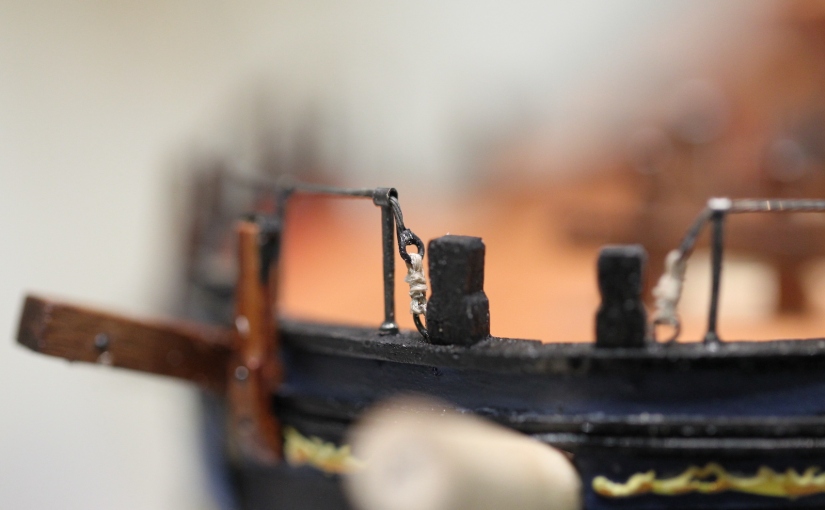
The foredeck railings around the bow of the ship were metal stanchions through which a rope passed. However, I had something more specific in mind for these. I wanted the same metal stanchions, but once again I really dig the little bit of coiled wire that I have and used for the hatch railings. Now as far as accuracy is concerned; it definitely falls into Category #2 under my previously explained decision tree: “Not 100% accurate, but looks cool.”
Stanchions first. I cut fourteen 1mm tubes and twenty eight 2mm tubes (two for each stanchion). The 1 mm tubes will insert into the 2mm tubes to create the wider portion at the bottom that then plugs into the railing. Another 2mm tube is soldered to the top of the stanchion as the eye through which the cable will pass. The top tube is soldered on larger, then filed down to be almost even with the stanchion, after which everything is blackened


Note: Trying to hold these things in place to be soldered took some ingenuity, extra clamp hands, and locking needle tweezers. During this process, more than a couple of these little escape artists went flinging across the room never to be seen again.
I soldered a ring on one end of the aforementioned cable and an eye bolt onto the other end. Here was a trick – I wanted to make sure all the stanchions lined up properly in terms of height, distance, etc – and then make sure the cable was the exact right length. I couldn’t just cut and tie it like a rope, so I had to pass the cable through the stanchions after they were mounted, measure the distance of the cable, then solder the eye bolt on the end of the cable while it was on the ship. Obviously paranoid about burning the ship up in a giant ball of polyurethane and wood flames, I used a piece of metal to block off everything that wasn’t being soldered. Very tense process – wish I’d have been able to take a photo of it whilst I was doing it.


The bow end of the railing is seized just as though it were a rope, and the waist end of the cable is mounted into the railing with the eyebolt. After writing this and seeing the photos – it comes across as a pretty simple process. However, it was quite complicated and very tricky to get correct and look realistic.


 The Lehman Shipyard