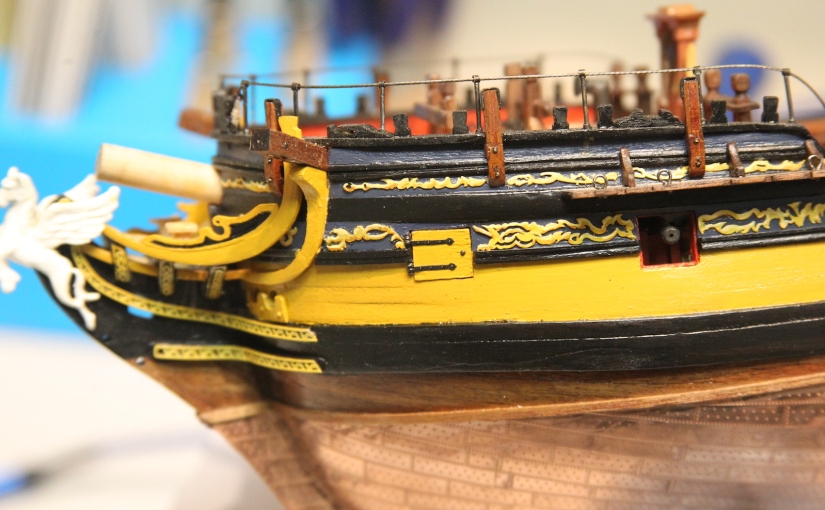
The gun ports are the openings along the hull and waist that provide access for the guns (of course). There is much debate about how many of these ports actually had lids, and what ports did not. I’m opting to go with one gun port lid on the aft-most opening, as this opening would have been accessed in a cabin. The other ports (particularly those along the waist) would have been open to the elements, and a gun port lid would have provided little benefit.
The fore most port is the Bridle Port, and different from the rest as it served a more specific purpose. Its main function is to assist with the tackle attached to the anchor when it broke water. The bridle port also served as ventilation for the foredeck (which housed the galley) as well as serving as access to a recovery area for injured crew members. Because of its different purpose, the bridle port hinges are horizontal, with the door opening sideways rather than upward like the gun port lids. Finally (and this was a mistake on my part), the bridle port should have been shaped differently, with a slightly more ‘portrait’ opening vs. square like the gun ports. My mistake was cutting its opening the same as the gun ports.
All of the doors are pretty straightforward to create – two layers of planks the same size as the openings. The difficulty lies with the hinges. Rather than try to cut my own, I decided to use some parts that I hadn’t intended to use – the kit provided hammock cranes; as I’ll be making my own later. I cut the eyelets off of these bits, and repurposed them as hinges by lining them up and inserting my smallest pin.


I sharpened the ends of the looped portions to create pins, then inserted them into the doors and also the hull. Then I lined up the hinges on the door to appear as one solid piece.


It’s worth noting that the bridle port door has a bolt on the outside as the ring bolt is on the inside rather than eye bolts like the gun port lids as there isn’t a need to open it with a line as with the gun ports.
I turned the gun port eyebolts from wire, fed them through the drilled out hole, then turned them again on the other side. This was a bit tricky using jeweler’s pliers and took some fiddling with tweezers once they were in, but created a more secure piece than trying to glue an eyebolt to each side.


Lids were mounted the same way as the bridle port with my manufactured hinges, then the rigging was added extending through two holes drilled just above the lid.


 The Lehman Shipyard