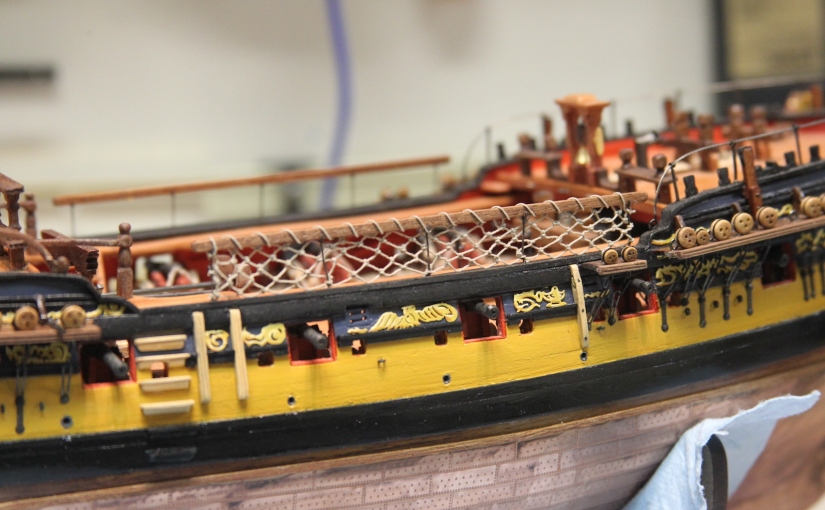
The ‘waist’ of the ship is the area between the quarterdeck and the forecastle (foc’sle), which was open on ships of this size and era. The gangways provided a means for sailers to traverse this area without having to run up and down the stairs and across the main deck. However, it was necessary to have some semblance of safety or sailors would have likely been tossed over board each time the ship dipped in a heavy swale. The waist rails provided this sanctuary of course. There is some flexibility here, as some waist rails were just a rough strip of wood mounted on stanchions, while others had some kind of netting. I chose the latter as it is illustrated in the “Fully Framed Model” (FFM) series.
The first step was to come up with the rough rail on stanchions. I used an oak strip to match other deck rails and stanchions.

I’d been noodling through how to make the netting along the waist rail and spent quite a while looking for a good “fishnet” representation – even going so far as to ask my lovely wife if she had any ‘delicates’ lying about that were no longer in use. I found a couple of ‘acceptable’ options at a fabric store, but nothing that I was really happy with. None of them looked like “rope” but rather just laced thread. Which meant coming up with my own version.
First, I tried weaving together my own netting using Dan Vadas’ example from his Jib Net here. My attempt wasn’t great.

This is after something like 6 hours mind you, makes tying off ratlines feel like a breeze. After all that, I still wasn’t digging it. I think it looks fine – and I may well still use it for a Jib Net, but I didn’t like it for the waist. So, after more research I found a good video on youtube and illustrated traditional net making for fishing. Though challenging, the method was transferrable to a much smaller scale and I was able to replicate it using .20mm rope. Here’s a shot with my first attempt on the bottom – which was pretty sketchy but a good practice to get the hang of it and improve my method. In the top one, I used more pins to hold my tiny work in place and thus create more even loops. I didn’t use any sort of net needle, I just used rope with the end stiffened with CA glue.

It still took 6 or 7 hours each to complete the netting which ended up being about 113mm long by 11mm wide. I then mounted it to my waist rail by first using a tiny dot of CA glue to attach the loops to the rail and stanchions, then tying off the loops to the stanchions, and finally looping and tying off another length of rope around the rail itself. I’ve seen other example of this looping on rails in this time frame – usually metal ones to create a better grip on the rail when wet. So I figure it too much of a stretch to have seen it on a waist rail.

Finally, it’s mounted on the waist. Last touches were to add another tiny drop of CA glue to hold the bottom loops even with the ship’s rail. Overall, this was a boatload of work (no pun intended) for a relatively small area and detail; and I still think it’s still a touch out of scale (especially the knots), but it’s about as small a rope as I could go and still successfully work the pa. But I’m much more pleased with this than I think I would be with a more modern alternative to netting.

 The Lehman Shipyard