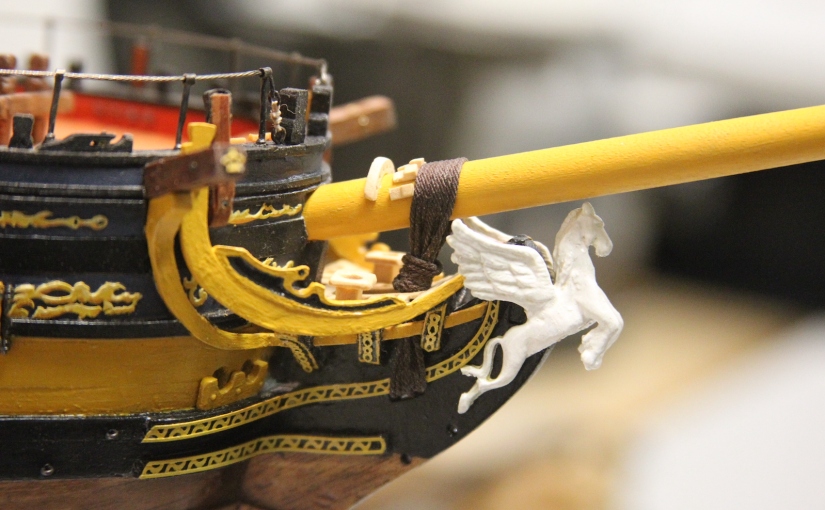
The spar that extends forward from the ship’s bow is called the bowsprit, and is one of the most notable (and I think cool) aspects of a fully rigged ship. That said, on many builds and kits the bowsprit is over simplified for ease of construction. In reality, by the mid to late 1700s, the bowsprit had become and complicated piece of engineering and rigging. As with the rest of the build, my intention with the bowsprit is to added those addition complications to provide as much accuracy as is feasible at this scale.
The spar itself is a round dowel, however it squares off at it’s tip so that ‘bees’ can be fitted and a jib boom can be added. The square end of the bowsprit is often overlooked in kits and instead both the bowsprit and jib boom end up being rounded off for simplicity.
There are a couple of way to achieve a round mast/spar with a square end; either start with square timber and round off the rest of the mast, or start with a larger size dowel, square off the end, then taper the rest down. I chose the latter method.
However, first, I needed to measure out where the taper and other aspects would need to take place. The base of the boswprit narrows, enters the bow, then is secured in the supports on the main deck below the forecastle. I used a dummy dowel to measure out the distance to these supports, as well as lining up where the gammoning (the ropes that secure the bowsprit to the ship) would take place in the headworks. These areas are marked on the dowel that will become my bowsprit.


The fore end of the bowsprit is sanded to square with the top three sides extending slightly longer than the bottom. The whole thing is put in a lathe and tapered at both ends until the fore end is slightly smaller than the square and the aft end fits into the hole at the bow of the ship. That same aft end is notched to fit into the support on the main deck (which we cannot see at this point, but can be seen in this post).


Now that the bowsprit is in place (at least temporarily) I am able to finish a couple of important elements on the forecastle – the bowsprit partner and the breast hook. I fashioned the partner from planks of Swiss Pear so it would have the same look/feel as the deck. I cut out the space for it, then added it in place. Worth noting is that the partner would most likely have been a single piece rather than planks glued together as I have it – but I’m pretty much out of Swiss Pear, so I’m adapting; and I didn’t want to use a color wood that was vastly disparate. Second: Also, most of this will ultimately be obscured by the breast hook and associated rigging.


The breast hook is fitted against the foremost bulwark of the forecastle and houses a number of cleats for rigging the bowsprit and other elements near the front of the ship. First, I measured the curvature using a piece of cardstock, then cut the breast hook from pieces of Swiss pear glued together to achieve the proper thickness. The piece is mounted with ‘bolts’ along the front.


The small cleats are made from boxwood and initially shaped by a round dremel tool before using small bits of sanding paper and sanding sticks to give them their final shape.


The base of the bowsprit is fitted with gammoning cleats which will hold the wrapped line in place where the bowsprit is secured to the ship through the headworks and a hole in the keel. Just behind the cleats is a ‘saddle’ that contains a set of holes to facilitate additional rigging.

The fore end of the bowsprit is fitted with ‘bees’ and a ‘cap’. The bees are a set of wide sheeves (pulleys) for the running rigging and the cap allows the jib boom to be joined.
The cap is a rectangular piece with a square hole that fits over the bowsprit and a round hole that accommodates the jib boom. In addition, the edges of the cap are angled to match the overall lines of the bowsprit. Finally, the cap also contains a rounded notch that will fit the “jack stay” – or small flag pole at the front of the ship.
The bees are flat planks to either side of the bowsprit bolstered by blocks on the bottom and then fitted with two sheeves on each side.
The other two elements on the front of the bowsprit are the jib boom saddle (where the end of the jib boom will rest) and the ‘woolding’ – a wrapping of strong line that strengthens the end of the bowsprit. This line is wrapped between two rings which I have simulated using electrical tape.
The entire fore end of the bowsprit is painted black and final elements are added – a series of eye bolts and the woolding line.


The bowsprit is secured onto the bow of the ship with the base inserted into the bow and secured in the aforementioned bowsprit bitts on the main deck. The gammoning lashes the bowsprit securely into place. After reviewing a couple of books to ensure accuracy, the gammoning consists of 9 to 11 wraps around the spar, twisting in the center, then feeding through the gammoning slot in the part of the keel called the “knee of the head.” As is stood, I could only manage eight wraps without looking funky – but the important aspect is that the number of horizontal wraps along the middle match the number of vertical wraps.

A note on rigging lines and color
I have decided to start making my own rope / line for this project which allows some flexibility and additional accuracy. It also allows me to adjust the color of the line to achieve what I believe is a more accurate build.
Most people have heard that the the running rigging of a ship (which was constantly moved, changed, and adjusted) has a lighter look, while the standing rigging on a ship (which was rarely adjusted) was tarred to provided protection thus giving it a dark look. This “dark” look is most often – almost always in fact – represented by using black line. However based on the research I’ve done, the standing rigging for British ships were often soaked in “Stockholm tar” which apparently had a more rich brown color. That’s the option I’ve chose for this build, hence the brown color on the gammoning pictured above.
And here are a couple of gratuitous shots of me turning my own rope.


 The Lehman Shipyard