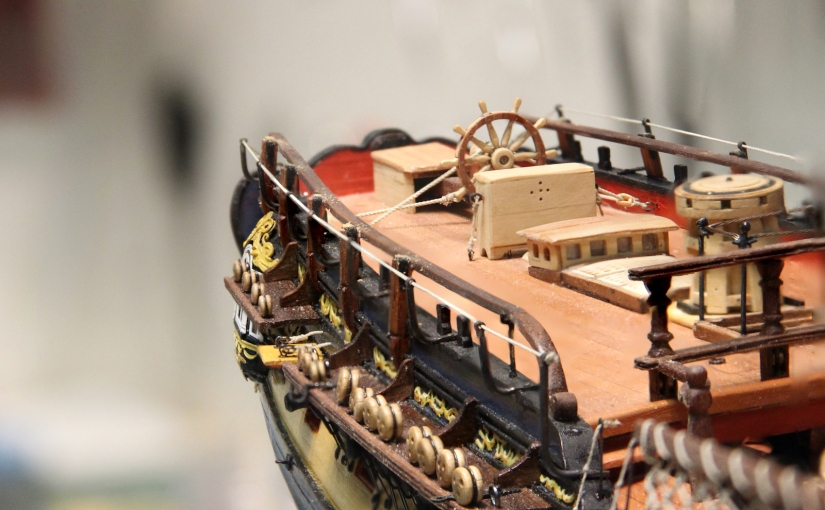
Anyone who has seen an historic sailing ship in person becomes immediately aware that space on these vessels (regardless of era or class) was at a premium. As such, spaces aboard had a variety of simultaneous uses. The 1776 HMS Pegasus is a Swan Class sloop with a 96 ft length on the gun deck and a 26ft beam (width) and held a compliment of around 125 sailors and officers. While shifts and watches overlapped and varied, all those folks had to sleep somewhere. The ‘where’ was on hammocks hung below decks when used, and stowed elsewhere when not used. Many of them were stowed using hammock cranes that stretched along the sides of the ship – as shown in the photos below.


While I don’t intend to create hammocks and load the cranes with them, it is important to include the hammock cranes as a detail. There are also varying sources that illustrate exactly where the cranes were located – whether along the waist, forecastle, or quarterdeck. Once again, I chose to follow the references from The Fully Framed Model series on Swan Class ships and located them along the quarterdeck parallel to the railing.
I started by cutting and bending lengths of 1mm diameter brass rod then flattening one end. My method of flattening is putting the end in the flat part of needle nosed pliers (the smooth area NOT the ridged area) then laying the pliers against an anvil and give it a couple of good whacks. The flattened bit does need to be shaped a bit afterward so that they’re all consistent width. I stuck a couple of pins in either end of the rail and ran a thread so I could measure the necessary heights of the stanchions as they ran alongside the railing. It’s important to ensure that the height of the hammock cranes falls short of the 1/2 pound guns – also figuring in the loops that are to be soldered to the top that facilitates the line. Stanchions are cut to height and a small bit of a 2mm brass tube is soldered to the top – same method as other railing stanchions on the ship.


Everything is blackened and mounted. A couple notes – I kept all the railings in order of height as I blackened them, which was a bit tricky. But I didn’t want to mix them up after I’d measured them all. I mounted them with a ‘bolt’ through the center of the flattened area. Technically, I should have used two bolts, but at this scale that was too much to ask. The fore end is knotted at the stanchion. Technically (again) this should have been pulled down and mounted on a ring bolt at the railing, but my wood railing is a bit too far forward for that and it looked terrible, so I compromised. The aft end is seized at a ring bolt.


As an additional detail, I also added the entry ropes. While they are pretty simple – just a couple of ropes tied with knots to assist climbing up the latter – it was a bit tricky getting the small knots an exact and consistent distance apart. The stanchions at the top are photo-etched metal pieces that were intended to use in a different area of the ship.

 The Lehman Shipyard