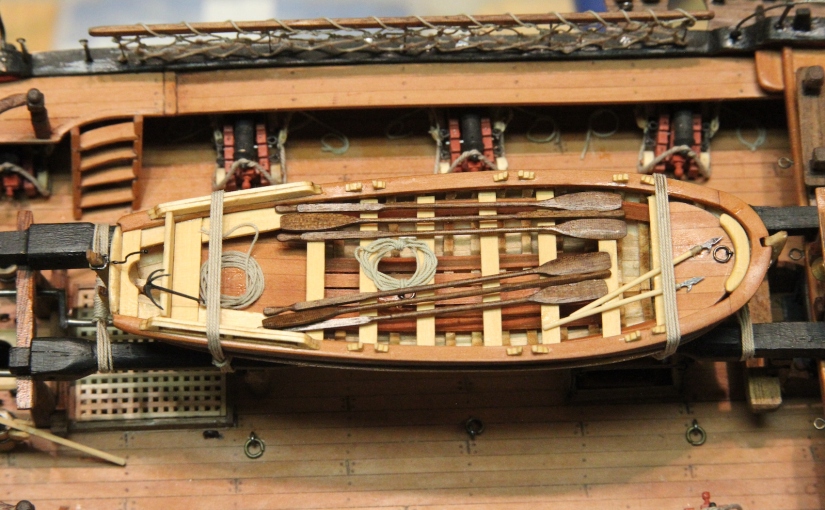
An age of sailing ship’s boats – or ‘life boat’ as most modern folks are probably accustomed to hearing it called – were as varied as the types of vessels and their captains. The shape and size of the small boats varied immensely ranging from shorter round “cutters”, to arrow-like pointed “yawls”, to a more generic “launch”.
For the Peg, I chose to go with the same small boat as was mounted on the USF Confederacy – the long, slender Pinnacle. I felt as though the sleek lines and rounded front fit perfectly with the sleek lines and elegant shape for which the Swan Class ships such as the Pegasus were well known.
That said – before I could build the ship’s boat, I had to create the area where she would rest. The ship’s boat on Swan Class ships rests across the waist (the middle of the ship) on top of two spare top masts. Creating this masts was a great opportunity for me to practice my technique for the fore and main masts to come later.
I used two different types of wood for the fore top mast and the main top mast respectively, and the first one turned out with much to be desired. It was an extra dowel I had lying around and I’m not even sure what kind of what it is – but it was too dense, very difficult to shape properly. The second was a basswood dowel which turned out much better. Which gives me a plan for the “real” masts that will come later.
As others have pointed out, the kit plans for the top masts leave out some detail, so I did some research with David Steele’s 18th century bookson seamanship and rigging and drew out my plan for the top masts. The books provide exact dimension for rigging and masts – all you need to do is a little math to convert to scale.

Each mast has several sections to it – some square, some octagonal, some round – and Steele’s dimensions lay it all out.
There are a couple of basic methods for creating masts in general, and masts with different squared off areas – you either start with a square piece of timber and round it off, or start with a round dowel and square it off where needed. I am more comfortable doing the latter.


If you start round, you of course have to start with a dowel a bit larger than your final product to accommodate the square and octagonal areas. In all honesty, my first two attempts at these masts are pretty rough under scrutiny – so I was grateful they are painted on British vessels.
Once painted, the spare masts are mounted along the waist atop the gallows and resting on either side of the belfry. After the spare masts were mounted, I went ahead and added all of the 1/2 pound guns and took stock of where she was after 600 hours of work.


With the spare masts are in place, I could start work on the ship’s boat. Since the Pegasus and Confederacy are both 1/64 scale, I was once again able to base my Pinnace on the materials gathered from the Confederacy.
I borrowed the bones from the Confederacy Pinnacle, then went scratch from there. The keel was pretty easy to duplicate – but the bulkheads not so much without a laser cutter or some kind – so I just outright stole the ones from the Confed kit.
A couple of things I did a little differently as I built upon the keel and bulwarks – I glued a strip to the top of the pieces that’ll later be removed. This adds LOTS of stability to the boat as you plank it. Otherwise, the much smaller pieces tended to wiggle around and get out of place – and yes, that crooked one was fixed first. Second – I actually double planked this little bad boy. The thin, narrow planks are really tough to get flush as you taper and shape them. Double planking gives me the opportunity to fill in some gaps with filler, sand smooth, then get the second layer of even narrower, and thinner planks really nice.


After the bulkheads are thinned and much of them are removed to reveal the frame, they are sanded even. Then the seat supports, floor boards, gunwales, and planking are added. For these parts I went with Swiss Pear to create a nice contrast against the boxwood, but to also match other parts of the Peg herself. This is a technique I used on the USF Confederacy and really liked.


The seating and oar locks are all boxwood – mostly because boxwood is the only timber dense enough to accommodate the delicate sanding. The oar locks were shaped with a needle file in one strip, then cut off before being glued to the boat. The rudder parts are brass shaped and blackened. Interesting note – the little round ‘handle’ on the tiller is a tiny bead that’s called ‘caviar beads’. Apparently they’re used as decorations on women’s fingernails. They were the smallest bead I could find on Amazon a while ago.


Many of the ship’s boats of the time were painted white along the hull, but once again I am choosing to leave the beauty of the natural wood color. However, I did decide to paint the sides of the pinnacle to match the same dark blue that is along the gun ports of the Pegasus. She’s then test fit in her place along the waist.


Next up are the bits and pieces that are stored inside the pinnacle; including a couple of harpoons, a grappling hook, and the six oars to match the number of oar locks.
For the harpoons there are photo-etched harpoon tips that are blackened. To create the harpoon itself, I sanded a dowel down to approximate diameter, then cut a notch into the end to hold the head. Then I wrapped it in place. This is based on both my ship research and my anthropology research for the time period. These photos are a bit deceiving, but those 1/64 scale folks know just how small these buggers are. I used a jeweler’s saw with the smallest blade I had to very gently stroke back and forth and create the notch.


The grappling hook is pretty straightforward, the photo-etched pieces glued, blackened and then attached to a coiled rope dabbed with some diluted white glue to hold it in place.

The oars at this scale a BUGGER. I started with a 5/32 x 1/32 piece of walnut. I used walnut instead of boxwood because once again I am paying very particular attention to my color schemes, and I want the oars to stand out from the launch, yet blend with the other walnut deck fittings. Anyway, I mark off the length of the paddle, and rounded and squared off portions of the oar. Then I trim/sand the handle square, only to finally round out the portions in the middle. Lastly, I thinned down and shaped the paddle ends. I think I ended up doing about ten of these – at least a few of which broke – to end up with the six that I wanted. This is a very slow, gentle, and tedious process of sanding. I’d guess that I probably devoted about an hour to each oar.

My ‘mounting’ technique in terms of where and how to place the items is a combination of organization and haphazard-ness. In other words, I don’t like an OVERLY organized or militant look to things, because it feels unnatural. Yet, I don’t want it to appear as though the crew is completely void of discipline.
First, the spare top masts are strapped down with strips of rope, and the pinnacle is secured similarly. Finally, the oars and bits and pieces are stowed and glued in place. I threw in an extra coil of rope for good measure.


 The Lehman Shipyard