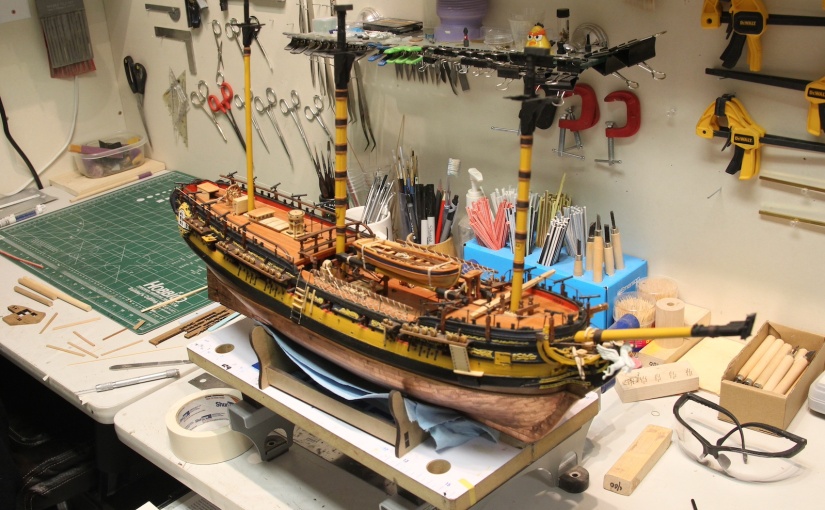
It may seem obvious at this point – but the Pegasus is a three masted ship. The masts, from bow to stern, are the Foremast, the Mainmast, and the Mizzenmast. The sizes of each are determined by the overall size of the ship. These calculations are laid out in the several times mentioned 18th century books by David Steel. According to Steel, the main mast of a Swan ship would be about 63′ high and about 18″ in diameter. The two other masts are then balanced against that. I won’t go into all the specific measurements here, but I sketched out the 1/64 scaled down version of the masts starting with the main at about 300mm total – some of which would of course be unseen below deck.

Each mast is broken down into several sections. The masthead at the top forms a frame upon which the topmasts will rest and be secured. Next the ‘hounds’ (which are also sometimes called ‘bibs’ form the foundation for the mast tops; the small platforms upon which sailors would stand watch or perform other duties. The mast tops are the more contemporary version of the old school “crow’s nest” of which most folks are familiar. The hounds/bibs make up the top portion of the mast “cheeks” – two long braces on each side of the mast that give it additional strength and stability. The cheeks are nailed in place against the masts but are also held in place with wooldings – hoops and ropes that wrap around the cheeks and masts to once again create additional stability.
So with all that – let’s get on to the building of the masts. I started by size, thus the mizzen at the stern of the ship. Step one is to get the mast in the lathe and taper it just a bit from deck to masthead. There really isn’t much taper to each of the lower masts. Next up, the middle of the masthead is cut down and squared off to mark the location where the cheeks begin and the bibs will be mounted. The rest of this masthead will be filled in again later. The cheeks are added at this point; worth nothing that the mizzen cheeks only extend down a few feet whereas they will extend 2/3 of the way down the other masts.


The bibs are mounted against the top of the cheeks and nailed into place. Two strips are added to fill out the masthead and steel wraps hold them in place. I’ve simulated these steel wraps by using thin strips of electrician’s tape. Additional vertical ‘battens’ are then mounted against those iron hoops to hold them in place. Just below that, the trestletrees (running fore to aft) serve as half of the base for the mast tops. The other half of the base (running port to starboard) is made up of the crosstrees. Small ‘bolsters’ are added to each trestletree where the shroud ropes will wrap around the masthead and extend down to the deadeyes on the sides of the shop. Then the entire top section is painted black.


The wooldings have bands that support the top and bottom of tarred rope wraps. I simulated these hoops by using thin strips of a manilla folder painted brown. The woolding wraps are .45mm hand made rope.


The Foremast and the Mainmast are very similar in process to the mizzen and have all the same elements. As mentioned before, the key difference is that the cheeks run 2/3 of the way down each mast. I am also able to add an additional detail to the longer cheeks – the nails that run up the sides and in between the woolding wraps.


The only distinguishing difference to the main mast is its increased size and the slightly more pronounced roundness of the cheeks.


I mounted all three masts in place (temporarily) to get a view of how the picture comes together and how they size up against one another.

 The Lehman Shipyard