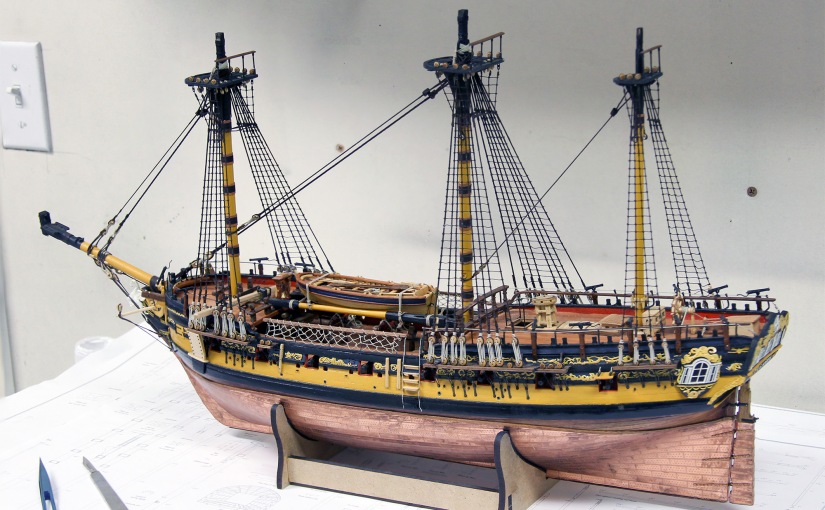
As the lower standing rigging continues, the ship really starts to take shape. It’s always a little bit of a challenge to add the standing rigging in a way that maintains a certain level of tension and stability without pulling things out of shape. As each portion is added – whether fore, aft, starboard, or port – the corresponding lines have to even out their counterpart to maintain the ship’s overall symmetry. In addition, the lines have to correspond to the ship’s rake, bowlines, and overall shape to look even and correct.
Futtock Shrouds
The futtock shrouds were pretty straightforward – particularly compared to the catharpins. The futtock shrouds extend down from the mast tops to the lower shrouds connecting them for stability, but also allowing a way for sailors to reach the mast tops as they ascend the ratlines. The futtocks themselves attach to the deadeye/futtock plates via a hook seized to a line. The bottom of the futtock loops over the futtock stave then seizes to the shroud.
Technically, the upper deadeyes are supposed to be a bit smaller than the smaller of the lower deadeyes – and the upper mizzen deadeyes smaller yet. However, I have a pretty large supply of 3mm deadeyes and the look is comparable in my opinion. So only using 3mm deadeyes and having them all the same size is a compromise I’m willing to make. I did however, make the futtock plates on the mizzen noticeably shorter by comparison.

After the deadeyes are all loaded up, I selected my hooks. Instead of the supplied hooks – which unlike the deadeyes are clearly too large, I went with my leftover hooks from rigging the cannon. I’m pretty sure they’re from Syren Ship Company, but I have such a random supply of fittings at this point, I have a difficult time remembering from where my blocks, deadeyes, or hooks etc, all come. At any rate, I did have to widen the holes on these hooks to accept the lines, and definitely broke a few and sent a few flying across the room while doing it. The futtock shrouds for the fore and main are .57mm diameter at scale; I’ll be using .50. And the Mizzen shrouds are .44mm; I’m using .40mm. The rather small plastic hooks were expanded just enough to accommodate those size ropes.


To attach the lines – I first measured the approximate length that I would need – about 50 mm for the fore and mains and 40 mm for the mizzen. Then I seized them all the to the hooks first. I attached the hook to the futtock plate, looped it over the stave then seized it to the shroud. Keeping the line taught while seizing – but not so much that it pulled on the rest of the rigging – was accomplished with a very tiny dab of CA glue right where the upper seizing would ultimately cover it up. I also alternated from port to starboard with each shroud to keep the rigging balanced as I went along.


Ratlines
The ratlines are likely the most recognizable and ‘famous’ bits of standing rigging on historic tall ships. They are of course the rope ‘ladders’ that sailors use to scurry about the ship and accomplish the rigging needs of the ship. There is however quite a debate regarding the color of the ratlines on ships. Most folks have likely always seen the ratlines as dark or black – mirroring the darker tarred standing rigging. However, the most accurate representations show the ratlines as tan, not tarred. That’s because the ratlines were most likely adjusted pretty frequently, but it was also not feasible for sailers – who were nearly always barefoot – to be running up and down tarred rigging. This representation is clear with ships like the HMS Victory at the Maritime Museum in Portsmouth, England. The Victory, Admiral Nelson’s flagship and the oldest still commissioned ship in the world, is a clear reference of ships of the era.

Another clear example is the Walrus the fictional ship in the television series Black Sails. Although not a real historic ship and was in service at least 75 or so years prior to the Pegasus, the producers of the show went to great lengths to ensure accuracy.

However, on the other side of the coin, most of the master ship builders I’ve seen and followed still go with a darker set of rat lines because at a smaller scale there is just too much of a contrast between the two parts of the rigging and it looks funky. This left me with a significant decision to make. After going back and forth and literally losing sleep over it, I settled on the darker ratlines. I think there will be plenty of contrast between the running and standing rigging, and adding lighter ratlines to the mix might just be too much. So this is another case where I’ll be sacrificing some level accuracy for aesthetics.
The ratlines themselves are made from line just over .10mm – which is as small a line as I can make spinning three strands Gutermann Mara 150 – the smallest thread they manufacture. The distance between ratlines is listed as between 13″ and 15″ – I’m going with the smaller end of that which is a distance of 5mm at 1/64 scale. I pulled out some old school graph paper with 5mm distanced squares and cut that to the shape of the shrouds and angled the bottom the lines are parallel to the ships lines. The graph paper is taped to the shrouds to keep it still as it serves as a template for the lines. The ratlines are tied across the shrouds using a basic clove hitch. After the first few lines from the top are secured I used my scaled sized seaman to test the distance and placement.


When tying off ratlines, there can be a tendency to over tighten the lines which causes the shrouds to get squeezed and alter the overall triangular shape. To avoid that, it’s good practice to tie off every third of fourth ratline, then go back and fill in the gaps. Each knot is touched with diluted PVA (white glue) and left to dry overnight before the ends are trimmed.


It is quite important (especially at this scale) to let the diluted PVA dry completely before you try and trim the edges otherwise the knots will unravel and you’ll have to redo some lines.

After the end knots dry, I use a brand new blade on my scalpel, hold the end of the rope as tightly as I can with my smallest tweezers, then gently cut the rope as close to the knot as possible with a slow back and forth sawing motion using only the weight of the scalpel. Trying to “slice” the rope does not work here and results in pulling and fraying.

There are a couple of small but very important differences between the mizzen ratlines and those of the main and fore masts. Predominantly, the first six lines on the top and bottom of both the main and fore shrouds skip the foremost and aftmost shrouds.

Otherwise the process is the same as the mizzen – once again skipping every few lines to prevent the shrouds from squeezing together or skewing. I used a long ruler to make sure my graph paper was positioned properly to the match the lines of the ship and remain consistent with the other ratlines. Obviously it would be eminently noticeable if the ratlines all had their own angles.

This is also one of those places where it really does make a difference when you use higher quality lines – another benefit of making my own. The polyester fibers do have a tendency to slip a tiny bit, so going through and adjusting the clove hitches across each ratline is paramount to maintaining some semblance of evenness throughout the rigging. I have some a bit more slack than others, but overall I’m pleased with the end result. This is one of those (many) parts of the build when patience really does pay off.


There are 784 total clove hitches making up the lower ratlines – including those on the futtock shrouds.

Shroud Cleats
Another often overlooked element of a truly accurate build are the shroud cleats. Many projects and builds opt for the much easier “belaying pin” which were in fact prevalent on many tall ships. However, some British ships in particular belayed rigging lines on cleats and railings. To create the shroud cleats I started with a 4mm x 10mm strip of a hard wood that I repurposed from an old cheese block we got as part of a gift basket. I often save random pieces of wood never knowing when they will be needed. Optimally, I would use English boxwood for this purpose, but it’s quite expensive and I don’t have any extra lying around.


Basically, the process involves mass producing the cleats by forming the shape using the strip, and then slicing them off. It’s a delicate process using a couple of different sizes of blades on my miniature table saw. First, a thick blade is used to notch the grooves on the side (deeper) and one on the top (shallow). The top is then shaped with a round sanding block, then a smaller diameter pin file. The grooves are shaped using a folded piece of sandpaper. Additional varying degrees of sanding shape the strip before a thinner blade is put back on the saw to cut the strip into 2mm wide cleats. My strip was long enough to produce more cleats than I need knowing that at least a few will be broken or lost during the process.


The individual cleats are then subjected to even more delicate sanding to round out the edges. More are lost to this process as well regardless of how gently I apply 600 – 1000 grit sand paper. Each survivor is then dipped into water based wipe on polyurethane to provide a modicum of strength for later rigging then left to dry.


After they dry, the final products are seized to the shroud. First, a tiny drop of CA glue is used to hold them in place against the shroud then they’re seized using Mara 100 thread. I ended up with 28 or so workable cleats, which should be a couple more than I need. I actually had a pretty difficult time determining exactly how many I’d need. After scouring the Fully Framed Model images I have, as well as some Swan class ships from other builders, I finally came up with a total of 26 – though it appears not all of them are rigged when all is said and done. Here’s my list (applies to both port and starboard sides): Two each side (port and starboard) on the Fore and Main Topmast shrouds, one each side on the mizzen top mast shrouds. Three each side on the Fore and Main lower shrouds, one on the aftmost Mizzen lower.

Euphroes & Crow’s Feet
One of the last elements of the lower standing rigging is the crow’s feet. These are a series of several very small lines that extend from the mast tops to the main and fore preventer stays. The goal of these lines is additional stabilization to the masts and the rigging under heavy strain. The crow’s feet themselves extend down to a uniquely shaped and lengthy block called “euphroes.” The euphroes have holes corresponding with the number of crow’s feet. The line begins on the top end of the euphroes seized to an eyebolt, extends up through a series of holes on the front of the mast top, loops back down through the holes on the euphroes, then back up to the mast top. The bottom of the euphroes are seized to the preventer stays using a two block method that allows for additional flexibility and adjusting. The real challenge to this set up is being able to adjust all these lines to create a proper amount of tension without distorting the lay of the preventer stays.
All of this is compounded by the very small size of all these parts at 1/64 scale. The fore and main are supposed to be just over 6mm at scale with the mizzen at a little less than 5mm. I quickly determined that I wasn’t going to be able to do that and get the holes I needed drilled, so instead I went about creating the euphroes the other way around. Boxwood is a must for these parts as they are very small and delicate. I drilled the smallest diameter holes I could get, as close as feasible, and let the overall length of the euphroes determine themselves. Six holes for the mizzen, 10 holes for the fore and main. The mizzen ended up at about 7mm long, and the fore and main at about 10mm long.


The shaped and drilled euphroes are fitted with a seized eye loop on one end and a 4″ single block and eye loop on the other. The edges were cut using my thinnest pin file to make room for the serving. The eye is served first then the euphroe wrapped, then the 3mm block, then another eye. The block-end of the euphroes are seized to the preventer stays for each mast. I started with the idea of serving it by feeding a line through the stay and wrapping it. This is how I did the mizzen. But this ended up not being the best method as it did not allow for shifting this rigging around to adjust the tension. Although I went with this on the Mizzen, I changed it up for the other two masts.


It was very challenging to get the tension correct without distorting the stays. If you tighten the crow’s feet too much, it pulls on the stay until it is out of place. If you keep too much tension on the stay, when you loosen it, all the crows feet relax and are askew. I hung a clip off of the stay to keep it reasonably taught for the mizzen until I could rove all the crows through. Which, in itself, is not an easy task without snagging just about every fitting on the ship.


Finally getting a balance took several tries and much adjusting. What I decided to do with the other masts, was to keep every seizing and knot loose until the crow’s feet were roved through – then I could tighten the blocks and each component individually until tension was maintain and the stays were not distorted. Once again, using a clip to loosely hang off the stay was helpful, but being able to adjust the block that is seized along the stay was most beneficial. Using this method worked a bit better and I was able to get a decent result on all three crow’s feet.


 The Lehman Shipyard