Shipbuilder Sean Lehman recreates historic sailing ships based on original plans and techniques.
Category: H.M.S. Pegasus
H.M.S. Pegasus, a 28 gun sixth rate frigate launched in 1779. The 1779 ship was most notable for having Prince William Henry (who would become King William IV) as her Captain for a brief time.
The Topgallant yards, or simply the T’gallants, are the upper most yards on a ship of this size. Only the main and foremasts have t’gallants on a sixth rate ship. These yards are also much simpler to outfit than the other yards. Both the fore and main T’gallants have just a pair of clueline blocks a short distance from the center. The horses do not have stirrups, with just a single on each side overlapping in the center. The blocks are 5″ (once again 2.5mm is the smallest I use out of sheer practicality) and the horses are 1.5″ (.20mm) lines.
Parrels
There is nothing simple about the parrels however. A smaller version of the others, these little things have minuscule ribs that are 2.5mm long at scale, and trucks that are under a millimeter. I spent half a morning just scouring my shop looking for things to use to meet these requirements. I tried a few things that just didn’t work before settling on a couple things that panned out. For the trucks, I found brown wire within an old ethernet cable. After pulling the copper out, I was able to slice the insulation into the appropriate sized trucks. At this scale (even measuring out a millimeter guide) I ended up cutting about 20 and then pulling out the ten that were the most consistent.
For the Ribs, I finally settled on a piece of thick, brown construction paper. Everything else I tried was either unmanageable at this scale (fell apart when I tried to cut, or manipulate) or was too think and looked out of scale. I started by cutting 3mm long by 1mm wide strips, cutting off the corners then creating a ‘notch’ with a scalpel to create the shape. The holes are made with a dental pick.
The parrel is put together on a .10mm line then attached to the t’gallant mast in the same way as the other parrels. First looped around the yard, then mounted to the mast wrapping the line around the ‘valley’ of the ribs and tying off each end. I took the picture of the parrel over the ruler on my hobby mat just to give some idea of just how small and fiddly this darn thing is.
Halliard Tyes
The t’gallant yard tyes are 2″ line (.25mm) with the fore being about 54′ (256mm at scale) long and the main about 57′ (270mm) long. The tye is hitched to the yard by looping the line under the back of the yard, bringing it up under the front, around behind itself then under the yard again, finally to be seized against itself.
The tye runs up the fore side of the mast, through the sheave in the hounds, then down the back to a 5″ (2.5mm) single block. Another 2.5mm single block is seized to an eye in the mast top. The falls of the tye run from the upper block, down through the bottom single, back up through the upper single, then down through the mast top to belay on the ever populated rail on the quarterdeck for the main and the bitts for the fore. With the masts lowered, the block on the halliard should be about midway down the length of the mast.
Lifts & Braces
The yard lifts are a simplified version of the other yards. The top of the lifts is either a pair of thimbles or small blocks hitched around the top of the mast – I chose blocks because they are (in my opinion) cleaner and easier at this scale. The lifts are eye spliced to the ends of the yard arms (instead of blocks like the other yards), taken up through the aforementioned blocks. then down through the mast tops to belay on the cleats fixed to the upper shrouds.
The yard braces are also a simplified version of the other yards. They too are just eye spliced around the ends of the yard arms. However, the fore and main have different routes along their rigging path. The fore yard braces run aft to a pair of 2.5mm blocks on a span clove hitched around the main topmast stay near the mouse. Each fall is then taken forward to a block seized to an eyebolt on each side of the aft part of the fore top. From there, it descends to belay on the cleats either side of the belfry.
I apologize for the photos above flipping back and forth from the port and starboard perspectives which is a bit confusing, but hopefully you still get the idea. The run of the main t’gallant braces is less complicated. They start as eye splices around the yard arm, run to a similar pair of blocks on a span hitched around the top of the mizzen, then descend to belay on the rail near the aft shrouds.
At this point there is obviously a LOT going on with all the rigging, especially as it travels through the mast tops. So it took (and will probably still take) a lot of rerouting lines so they aren’t fouled or bind against one another. I’ll continue to take a look as this as I start to secure lines and add coils of rope – which will be my next step. It’s also worth noting that according to Marquardt, T’gallant sheets were not used between 1735 and 1790, and I can’t find any solid references to determine how the uppermost clue lines may have been rigged without sails; so those will not be included. With that, this marks the end of the running rigging for the Peg.
I’m starting on the topsail yards with a little different approach that the lower yards. Instead of doing them one at a time – I went ahead and attached all the necessary accouterments to the three topsail yards before rigging them. One more quick note here – While the kit shows an additional t’gallant yard on the mizzen, most other sources show that a ship this size would not have that additional level of mast or yard (I mentioned this when stepping the upper masts).
My process this time was to start with the stirrups and horses on each so I could stiffen them with diluted PVA before moving on to blocks. For the mizzen, the stirrups and horses are 2″ (.25mm). Sheet blocks are 10″ (4mm), clueline and brace blocks are 5″ (2.5mm is the smallest block I use). Brace pendants are 1.5″ (.20mm).
As with the lower yards, the main and fore topmast yards have the same blocks as follows: 14″ (5.5mm) Tye Block with two 7″ (3mm) buntline blocks attached, two 6″ (2.5mm) sheet blocks, and the pairs of clueline, lift, and brace blocks are all 8″ – which is a bit of an in-between size, so I’m using 3.5mm blocks simply because I have more of them. Note: There is some controversy here on whether the 14″ Tye block is single or double and a well documented error in the Fully Framed Model) – but I will cover that later when I address rigging the fore and main topsail yards. For now, just know that I used a single block and will explain why then.
Mizzen Topsail Yard
Based on the Fully Framed Model as well as Lees’ Masting & Rigging of English Ships, I’m using a truss parrel instead of a parrel made of trucks and ribs that you’ll see for the other topsail yards. This is based on the smaller size of both the yard and the ship itself. The truss parrel is a set of two 2.5″ (.30mm) lines (one short and one longer) that end in a seized eye. Each wraps around the yard and seizes to itself before both eyes are seized together.
The yard tie and halliards originate in the middle of the yard with an eye seized and the line wrapped around the center of the yard and up through the eye. From there the line runs up through the sheave in the top of the yard and down to a set of blocks, the bottom of which seizes to an eye bolt on the tressletree inside the top rail. Even though every source calls for this location of the eye bolt, this immediately created an immediate issue with the lines fouling against the mast cap. So I relocated the eyebolt to the mast cap itself which solved the issue. As with all the topsail yards, the mizzen is mounted in it’s lowered position, which is proper without sails. This means the upper block on the aft of the mast has to be high enough to allow for the run of the yard when it’s raised.
The fall of the line belays to one of the cleats at the base of the mizzen mast.
The yard lifts of the mizzen are a simplified affair. Instead of lift blocks on the ends of the yard, the lifts (.25mm) are simply eye-spliced over the ends of the yard, then run up through the bottom of the sister blocks seized into the shrouds before falling to belay on one of the cleats at the base of the mizzen mast.
The braces are relatively uncomplicated as well. While the FFM suggests each brace eye splices over the gaff, I chose to measure out the entire line for both port and starboard braces and used a clove hitch on the gaff. This gave me some extra flexibility when adjusting the tension of both sets of braces before belaying them. So, the standing end of the braces starts at the aforementioned clove hitch, runs up through the brace blocks on the ends of the pendants, back down through the pair of brace blocks on the end of the gaff, then down toward the deck.
The FFM shows the braces heading down to run through a lead block seized to an eyebolt on the quarter piece before running through the fixed sheave on the rail. Once again, I don’t have that sheave back there, so I made another adjustment. My lead block is seized to an eyebolt at the aft of the deck before belaying on one of the timberheads
This change to the fall of the braces has the added benefit of creating slightly more separation between the braces and the vangs which creates a cleaner look.
Fore Topsail Yard
Before beginning the rigging on the topsail yards I noticed I was missing a couple of blocks not shown in the Fully Framed Model plans – which does not include bunt lines and leech lines. Two buntline blocks are added under the heads next to the jeer tyes.
Unlike the mizzen mast, the fore and main topsail yards are fitted using the more traditional truck and rib parrels rather than just a truss pendant. The parrel is made up of six “b” shaped pieces of wood that make of the ribs and separate the trucks which are barrel shaped separators (the same as the gaff parrel). While the kit comes with small metal ribs, they are not quite the right size of scale for my application. I also wanted to use wood rather than metal to be more authentic.
Although there are only a couple of pictures here, this was a LOT of work. The ribs are 5mm wide and about two millimeters tall. I started out by shaping a length of harder wood in those dimensions then using a round file to create the valley in the center. The piece was cut into one millimeter slices with holes drilled into the rounded portion. Finally, each parrel was individually sanded and shaped into it’s final appearance.
After test fitting the parrel on two 2″ lines, I stained them darker so there would be lest contrast between the trucks and the ribs. Mounting the parrel itself is a fiddly process. The two lines start with an eye seized in one end. Those two ends wrap around the yard and are seized together. The loose ends wrap through the ‘valley’ of the ribs around to the other side of the yard where one goes over and the other goes under. It then wraps back through the valley to repeat the process two more times before being seized together. This is a very confined space to accomplish all of this and took a fair amount of patience.
As I hinted at above, there is some confusion regarding the rigging of the topmast tyes for the fore and main topsail yards. A well documented error in the Fully Framed Model has a 14″ single block is listed in the text of section 19.15 regarding the fittings on the yard. However, when referring to the actual rigging in section 19.25 it lists a double block. The use of the latter is confirmed in Lees’ Masting and Rigging of English Ships as well as David Steele’s description. Steele and Lees describe the tyes as originating as loops over the topmast head above the shroud wrappings then descending through the double block, back up to the single jeer tyes, then down to seize at a double block where the falls occur.
Here’s my problem – I simply don’t have enough room to loop anything else over the topmast head without interfering with the double sheaves. Further – Steele actually refers to a single block instead of a double for the topmast yards on smaller vessels – specifically sixth rate ships with fewer than 20 guns. This was the perfect excuse for me to go with the single 14″ block rigging. In this case, it means that the tyes themselves are rigged more similar to the lower yards.
A 14″ double block is spliced into each end of the tye. I start with one end of the 4.5″ (.60mm) tye line secured onto the double block, the other end is fed up through the jeer tye, then down to the 14″ single block in the middle of the yard, back up to the opposing block under the mast top, then down to the second double block – thus creating the same “M” as with the lower yards.
The falls themselves are made of 2″ (.25mm) line with the standing end secured to a single block with a long stropped hooked to an eyebolt in the channel just aft of the shrouds. The line then runs up through the outboard hole of the double block, down through the single, back up through the inboard hole of the double, then back down again to belay on the rail. Since I substitute my fore rail with a snazzy cable line, my fall will belay on a convenient timberhead.
Here’s a layout of the entire tyes and falls with some notes as it’s difficult to see the fall of the line amidst all the other rigging. Note that when taught, the two double blocks at the ends of the tyes are located about the height of the masthead. It takes some care to adjust all the lines so that the two blocks are even with one another. Once again, the topsail yards are fitted in the lowered position when sails are not present.
Main Topsail Yard
The main tyes, halliards and their falls are essentially a mirror of those of the fore mast (same sizes of ropes and blocks) with the exception of where they secure and belay. In case of the mains, the eyebolt is located in between the sets of stays at the swivel gun. One must pre-measure the falls to avoid any fouling, particularly with the swivel gun. The following pictures show the run of the line from the 14″ block in the center of the yard, up through the jeer tye blocks, down through the tackle between the double and single blocks before they belay on the rail.
Yard Lifts
The Topsail yard lifts serve the same purpose as the lowers of course (to square the yards) but are rigged a little differently than the lower ones. Instead of running through blocks at the mast heads, they are run through thimbles. Each of the fore and main upper yard lifts start with a 30′ (140mm) span of 2.5″ (.30mm) tarred line that end in thimbles. The span clove hitches around the topmast cap. The thimbles are lashed to corresponding thimbles seized in the standing ends of the lifts themselves – which are of 2.5″ (.30mm) untarred line.
The lifts then run down to the lift block on the end of the topsail yard, back up through the lower block of the sister blocks seized into the shrouds, then down through the every shrinking amount of space in the hole of the mast top.
The fore topsail yard lifts belay to a timber head on the fo’csle railing, while the main lines belay to a shroud cleat.
You’ll also notice in the images above that I’ve attached the studdingsail booms to the topsail yards at this point – just prior to adding the yard lifts. The booms are mounted in the same way as the lower version.
Topsail Yard Braces
The topsail yard braces for both main and fore are similar in that they involve a separate span with single blocks on the ends to facilitate the run of the lines. In this instance it was much easier for me to start with the main. The span for the main braces is a 21′ long (just about 100mm) 3.5″ (.40mm) tarred line with an 8″ (3.5mm) blocked seized to each end. This span is clove hitched around the mizzen mast just above the cross jack. Both the length of the span and its exact location needs to be pretty precise to prevent the braces from fouling with any other lines – especially the crow’s feet. It is definitely tricky trying to tie a clove hitch in this area especially with blocks seized to the end and still get each end of the span equidistant from the other.
The standing end of the braces (.30mm line) is hitched to this span above the blocks (see above right) then runs through the brace pendant on the end of the yard. It runs back through the block on the span then down to belay at one of the mizzen cleats at the bottom of the mast.
The fore topsail braces are a similar process but a little more complicated. These braces utilize TWO spans, both of which are hitched to the main stay. One is located just below the fore yard brace blocks, the other is located just above the belfry. Both spans are still .40mm tarred line with 3.5mm blocks on each end. The spans are a bit shorter (about 40mm for me) as they only wrap around a line instead of a mast. Still quite tricky to get the ends equidistant. The standing end of the braces starts on the main stay just below the standing ends of the fore braces. Note: Just like the fore braces, I chose a clove hitch of a single very long line rather than two separate standing end hitches which (to me) creates a little bit of a bulky mess.
From there, the braces run up to the brace pendants on the yard, back to the blocks on the upper span, down to the blocks on the lower span, then down to belay on the inner ends of the fo’csle breastwork rails.
As you can see, the railing is getting a little crowded. And I suppose it goes without saying that things are starting to get quite complicated over the main deck of the ship at this point, and rigging is becoming an expert level version of cat’s cradle. Understanding that it’s getting difficult to follow the run of the lines, here are a couple of photos to indicate the locations of the spans and hitches.
Once again, the level of engineering on these ships amazes me. Planning the runs of the lines in ways that keep them fully functional without fouling is something that has always (and continues to) impress me.
Clues & Sheets
The clues and sheets on the topsail yards are a little more straightforward in terms of path as compared to the lower yards. However, they do take a fair amount of preplanning to run the lines so they are functional and don’t foul other lines. The main topsail clue lines follow the same general pattern as the lower yards. The sheets (.40mm) are crown knotted (mine is simulated) and fed through the strop of the clue block (3.5mm). The clue lines are .30mm with the standing end timber hitched to the yard, run through the clue block, then back up through the clue block on the yard before heading down through the hole in the mast top to the deck. The Sheets run from the crown knot down to the lower shoulder block on the end of the lower yards, behind the yard to the quarter block then down to belay.
The main topsail clue lines run down to the breastwork at the mast or one of the available eye bolts. The fore lines belay on the bitts at the base of the mast. I’ll be completely honest here – at this point, I’m finding any available railing, bitt, or eye bolt that allows for belaying without fouling any of the lines. There is VERY little room at the base of the masts at this point and belaying points are at a premium. Even so, lines have been rearranged multiple times to run free of binding.
The Mizzen clues run in the same fashion, and once again I find real estate to belay lines. As with the others, I’ve shifted the lines around at the base of the mizzen several times at this point, and will likely shift them more.
Bunt & Brail Lines
Once again (as with the lower yards) I’m running bunt lines even though there are no sails. Following the same policy as the lower yards, the buntlines for the topsail yards will knot at their respective blocks, then run their course. In the case of the topsail yards, the bunt lines are knotted at the two blocks attached to the center of the yard, then run up to two more blocks at the mast top before heading down along the mast to belay.
Following my policy of running sail lines without sails as much as possible – I’m also running the mizzen’s brail lines. These are similar to the bunt lines on the other yards, but unique because of the nature of the ship’s aft most sail. These are not something I’ve seen on very many (if any) models without sails. But, once again, I don’t like seeing “empty” blocks, and the three pair of brail blocks on the gaff would typically hold the sail. The three pair are the throat brails (closest to the mast), the middle brails, and the peak brails. According to Marquardt (pg 214) and Lees (pg 109) the peak would belay at a cleat on the aft spirketting – I’m substituting an eyebolt in that area. The middle would run through a lead block down to a shroud cleat, and the throat brails would belay at the mast. As with the buntlines, I’m knotting the lines at the blocks and then running them along their designated path.
As the rigging continues to multiply, the ship becomes a chaotic, but well orchestrated run of lines – all of which have a specific function.
Next up, the top most yards – the Topgallants – or more commonly the T’Gallants; the final aspect of the running rigging.
As mentioned in previous posts, the running rigging is further broken down into subcategories. Some running rigging manipulates the yards themselves – helping to steer and align the ship, while other running rigging attaches and manipulates the sails themselves. The latter is often left off of models where the sails are not included. However, I felt it was important to include as much of this rigging as is feasible to maintain the accuracy of the model.
Braces
Braces are elements of running rigging on a squared rigged ship that rotate the yards around the masts allowing the ship to sail at different angles to the wind. The braces are fixed to the outer ends of the yard attached to the brace blocks seized to the longer brace pendants. The fore braces start with a very long .30mm line that starts at a clove hitch on the main stay just below the mouse on the main stay. Each side of the line runs out to the block on the end of the brace pendant of the fore yard (outboard to inboard) and back to a pair of single blocks stropped to the main stay just below the euphroe. The line then heads down to the main deck to belay on the rail by the hatch and water pumps.
The main braces are even more straighfoward. Still a .30mm line in which the standing end is seized to an eye bolt just above the quarter galleries. The line runs up through the blocks at the end of the main yard brace pendants then back aft to run through a sheave at the very aft of the railing. Because of the limited space I have at the aft of the ship, I didn’t have room to install the needed sheave, so instead I belayed this line to the post that holds that swivel gun.
The crossjack braces are a little more complicated. There’s also an extra complication in that they cross over one another as they are rigged – something to which one should pay a bit of attention. A smaller line at .20mm, the standing end of these braces clove hitches to the end lower shroud on the main mast at approximately the same height as the crossjack. The line crosses to the opposite brace pendant block and then back to a single block seized just below the hitch. From there, the line heads down to belay on the rail near the shroud. This arrangement is mirrored with the other crossjack brace pendant, however, it’s important that the opposing clove hitch and single block are seized one ratline lower (or higher) so that the lines down’t foul as they cross.
Clue Lines, Sheets, & Tack
Clue lines, sheets, & tack all fall into the subcategory of running rigging that hold the sails to the yards (similar to buntlines and leechlines) and adjust them while underway. Because of where and how they are rigged, I think the clue lines, sheet, and tacks are some of the most prominent rigging on the ship. Like the bunt lines and leech lines, the aforementioned rigging is also a little bit of a challenge in terms of presentation without sails. For instance, when not actually attached to sails, the sheets and/or tacks can chafe against the back stays – which likely ins’t much of an issue when the ship is in port. At any rate, I took a long look at how to present these lines before getting started. During that long look – I discovered that I was missing an important sheet block along the railing in the middle of the ship that I’ll need for the main course, so I started by adding that.
These three elements all work simultaneously to manipulate the sails. The lines start with a unique setup of blocks with the 9″ (3.5mm) clue block and a 14″ (5.5mm) sheet block. Although the Fully Framed Model describes a special type of “shoulder” clue block, Lees indicates that after 1773 regular single blocks were used. Both blocks are stropped with a loop and the loop of the sheet block goes through the loop of the clue block. They are then held in place by the tack whose end is a crown knot. A crown knot is a specialized knot in which the threads of the rope are separated and then tied together in a ball shape. This is nearly impossible at this scale, so I simulated my crown knot with a modified timber hitch pulled tightly.
The standing end of the clue line (.30mm) is timber hitched to the yard, runs through the clue block at the clue/sheet combo, then up through the clue block at the yard, then down to belay on the railing at the base of the mast.
It’s important to note here the I pre-measured and started the rigging of all three lines that juxtaposed so that I could make the adjustments at the same time. Obviously, when all three lines connect this way, any adjustments to each individual line affects the other two – so all three must be adjusted together to get the presentation you’re looking for. For instance, I started my timber hitch pretty far inboard on the yard – however, the standing end ultimately ended up pretty far out on the yard (both main and fore) to allow the sheets to clear the stays. For both Main and Fore courses, the sheets are 4.5″ (.60mm) and the Tacks are a hefty .70mm. The main course tacks go through the chesstree sheaves, the nearby fixed blocks, then belay on the cleats inside the bulwarks – which, btw, took my very longest tweezers, and a generous amount of patience.
The standing end of the main course sheet is seized to an eyebolt on the quarterdeck plansheer, runs up through the sheet block, then back down to my newly added sheave before belaying to a nearby timberhead. Here’s the problem for me – with this arrangement the line is tight against the gun post and definitely chafes against the stay. It is my general approach that anything that rubs, chafes, or fouls deserves a second look. So after doing a little more research (and yet another good clue from B.E.’s Peg build), I found an alternative in Lees. He indicates the use of a lead block in the side above the eyebolt. I chose this alternative with one adjustment – I added my lead block on the channel instead, which provides a little more room and felt more functional to me. Here’s a side by side look.
The starboard side is a mirror to the port side. All lines are once again adjusted together to ensure they clear the stays, etc. Once lines are adjusted they’re held in place with a touch of CA (superglue) to await final coils of rope later.
The fore course (“course” simply means the route of the rigging) is set up very similar – same clue / sheet / crown knot combination. The clue runs the same path, starting with the timber hitch then running through both clue blocks and down to belay at the base of the mast. The tack runs down through the large block at the end of the boomkin then up to a fore timberhead. The standing end of the Fore Course Sheet is seized to an eyebolt below the aft fixed block, through the sheet block, through the fixed block, and belays to the aft cleat in the bulwark.
Once again, all three lines are adjusted until a layout that avoids chafing and binding is achieved. The spritsail clues and sheets are a simplified version. Spritsail clues are 1.5″ (.20mm) and the sheets are 3″ (.40mm). A crown knot is still used, and both the clue line and sheets belay to a cleat at the bow.
A look at the overall run of the sheets and tacks.
As the name implies, the yard tackles are similar to the main stay tackles in that their primary purpose is to facilitate hauling gear and supplies aboard the ship. Situated on the ends of the main and fore lower yards, they’re able to serve as cranes as they yards swing back and forth. The tricing lines are used to manipulate the yard tacks and stow them when they’re not in use. Similar to other rigging, there are a number of different variants to tackle rigging depending on the time frame, ship size, and even author of reference material. There doesn’t seem to be much debate as to the fact that the tackles (that end in a block and hook) are stowed against the futtock shrouds in most cases when not in use. This method is illustrated In both Lees’ The Masting and Rigging of English Ships of War as well as shown on contemporary models. The tackle itself is 2.5″ (.30mm) line with a 9″ (3.5mm) single block stopped with a hook at the lower end of the fall. The standing end of the tackle starts with the single block, runs through the smaller end of the yard tackle violin block (on the pendant) back up through the single with the hook, down through the larger end of the violin, then back up to coil and hold fast at the futtocks.
I then coated all the parts with diluted pva and hung clips about to help it hang naturally. Notice the above image contains the outer tricing line. Let me address that. First, the tricing lines are all .15mm line. There are a couple of different variations of what to do with them. According to the Fully Framed Model, the outer tricing line attaches to the end of the yard pendant’s violin block, runs through the outer tricing line block, then up to at cleat at the mast cap. I ran this line and it looks really funky to me and just begged being fouled. It also seems pretty impractical in terms of actually manipulating the tricing line. Lees has the tricing line for the fore yard going through the outer block and then “belaying to the fore topsail sheer bitts next to the upright.” That’s what I’ve done here:
While this appears to be much more functional in terms of usage – it still looks really awkward with the line crossing the entire fore deck as it descends from the yard to the bitt. Then, I consulted Marquardt’s Eighteenth Century Rigs & Rigging where on page 73 he says “the outer tricing line was spliced to the upper strop of the [violin block] ran through the lead block fastened to the yard … then through another [block] at the catharpins height lashed to the shrouds to belay finally in the lower shrouds.” This arrangement is the one that resonated with me the most compared to the other two and is eminently functional and practical. So I removed the line pictured above, attached the single block (using a 2.5mm) to the shrouds at the catharpins and ran the outer tricing line as described.
The outer tricing is belayed to the second shroud cleat leaving the outer one for the inner tricing line. The inner line is run based on the FFM’s description – attached to the tackle at the single block with the hook, run through the inner block on the yard, then down to the outer shroud cleat.
The main yard is a mirror of the fore yard. Here are some additional photos showing the layout with the new single block attached to the shroud at the catharpins for the outer tricing line and then each element of both tricing lines finally belaying on the shroud cleats.
As describe in previous posts, there are two major types of rigging on a square rigged vessel – standing rigging and running rigging. In short, standing rigging, which was darkened through the use of tar, was fixed in place to hold the masts and other parts of the ship in place. The running rigging was natural (not tarred) to allow for freedom of movement. Within the running rigging, there are two further categories of rigging – that which was used to mount, adjust & move the yards and spars, and that which was used to hold and manipulate the sails.
It can be argued that for a ship model that will not have sails (such as I’m building with the Pegasus) one can omit the latter of the running rigging that holds and sails. However, I believe it is important to represent as much of this rigging as possible to not only maintain accuracy, but represent how a ship works for those interested in the learning aspect.
To that end, the bunt lines and leech lines both fall into the “hold and manipulate sails” portion of the running rigging. These lines attach to the sails and then run through the blocks along the yards. as it turns out, there are a few different representations of how this kind of rigging was handled when sails were not present. This is unsurprising when one understands that rigging styles are very dependent upon type of ship and time period. It’s further varied based on the needs and preferences of the Captain of each ship. Needless to say, much research was done leading into this area of rigging.
Buntlines
Buntlines hold up the middle of the sail and facilitate its attachment to the yards. The Fully Framed Model and David Steele’s Elements of Rigging agree that the buntlines start by being knotted and pulled up taught against the yard buntline blocks when a sail is not present. Then they feed through the yard blocks under the main top. Some references have them being pulled through the fore then aft blocks before belaying. Then, where they belay is definitely a varied opinion with some indicating either a “leg and fall block” or more standard block. After much research, I settled on the reference of James Lees’ The Masting and Rigging of English Ships of War which indicates the buntlines running through two single blocks stropped together with both the main and fore versions belaying on the Foc’sle belfry rail.
Starting with the main lower yard, I used a .20mm line I’ve run through the outer buntline block, up through the inboard hole of the outer double block (the outer hole will be for the leechline) from aft to fore, then down to the stropped single blocks. After looping through the upper single block it travels back up to the outer hole of the next double block and down to the inner buntline block on the yard. Note: I’ve posted the same picture of the double blocks twice just to make it easier to follow the path.
The bottom of the two stropped blocks holds the falls where the inboard end feeds through the sheave of the belfry rail then belays to the rail and the outboard line belays to the rail next to it with a timber hitch. Care must be taken when stropping the two single blocks so they don’t twist too much otherwise it’s very difficult to prevent the lines from twisting as well. It’s also important to think ahead when determining where the double blocks will end up or you run the risk of interfering with future rigging in this area.
The fore lower mast buntlines follow a very similar arrangement – however, the lines run up through BOTH the fore and aft double blocks under the mast top to drop down and belay at the same rail. Also the actual blocks under the tops that are used are different because one of them is already taken by the spritsail’s rigging. With the fore, the buntline originates with the outer block as with the main then runs up through the outboard hole of the FOREMOST second double block, back to the matching aft double block then down to the stropped singles. After looping through it comes back up into the inner hole of the same set of blocks before heading back down to the inner buntline block. Similar arrangement at the bottom with both lines belaying to the rail.
Leechlines
Leechlines are small diameter lines that run through the leeches (or the back edge) of a sail to help it maintain tension. Similar to the buntlines, the leechlines have some deviation in terms of reference, so I made the assumption that they would follow the same pattern as the buntlines since they are similar in nature in most other ways. Only showing the fore here, but the leechline is knotted at the block (as with the bunts), runs up through the set of outer double blocks (fore then aft) and down to a single block that falls to belay on the rail. Once again the outer fall goes through the sheave before belaying with the inner line belaying on the railing next to it.
Worth noting above that I needed to feed the leechline inside the futtock shroud to avoid fouling. On the main yard the leech lines start at the block (just like the fore yard), run up through the outer hole of the outer double block under the mast tops (the hole we left empty while running the bunts), then down to belay on rail near the hatch as shown.
Once again, I can’t guarantee the complete accuracy of this arrangement given the limited and sometimes contradictory references. There is definitely an element of “best guess” when it comes to rigging, but this arrangement seems eminently practical and reasonable so I’m comfortable with it.
The mainstay tackle is used to load and offload materials (and the small launch boat) and so there are two – one located above the foremost hatch on the main deck and one over the aft hatch. The FFM calls for a 12″ double block hanging from the main stay – the more aft block from a longer 3.5″ inch pendant and the fore block stropped directly to the stay. Each is then tackled to a 12″ single block stropped with a decent sized hook with a 3.5″ line that’s then belayed on the deck. I actually made a couple minor changes here. The 12″ blocks this scale are 4.75- to 5mm, but I beefed those up slightly to 6 mm. I did this for two reasons – one, I believe the 3.5 line (abut .45mm) overwhelms smaller block and balances better with the 6mm block. I also really like this very visible part of the ship’s tackle (much like the anchor rope) and wanted the blocks and rigging to be large enough to make out the details without too much effort.
As I said, the aft block is attached to a pendant – which is about 21′ feet, which is about 100mm at scale. I positioned this block / pendant directly over the aft eyebolt in my launch and lashed the standing end to the mainstay. I then coated it generously in diluted pva and hung a clip to it to let it dry and stiffen. The lashing itself is an eye seized in the .45mm line then wrapped to the mainstay and half-hitched. This is where the stiffened line, still held with a pretty heavy clip, came in handy as I wrapped the lashing and tied it off. I did put a spot of CA glue on the mainstay to hold the pendant in place.
The tackle itself is a 1.5″ (.20mm) line stropped to a block with a hook made from a long eyebolt. The line starts with the single block, runs up through the double block, down to the single, back up through the double, then back down to belay near the deck. The companion block to the fore of the deck is the same process without the pendant, lashed the same to the main stay.
There are a variety of options to where this may belay – each book / person seems to have their own spot. The convenient location(s) for me were the eyebolts along the anchor rope since the cannon aren’t attached to them. It’s important to adjust the tension of the tackle so it is taught, but doesn’t drag down the mainstay.
Studdingsail (Stun’sl) spars
Before getting too deep into more of the lower rigging, it’s important to mount the studdingsail booms. These booms run along the yards and protrude pas the ends to facilitate the studding sails – or stun’sls. The Stun’sls were extra sails used in fair weather to increase speed. The stun’sl booms feed into the irons as far as feasible and are held in place with a tiny spot of CA glue. The inboard end of the booms are then wrapped with .60mm line very similar (but smaller of course) to the gammoning rigging on the bowsprit.
The gaff is the aftmost yard on the ship which extends from the mizzen mast toward the keel. This spar holds the rear sail. Similar to the Spritsail yard, there is a disparity between the Chris Watton’s plans that come with the kit, and the plans in the Fully Framed Model book by David Antscherl. Watton shows both a driver gaff (the upper spar) and a driver boom (the lower spar), whereas the FFM only shows the upper gaff. As with the spritsail, I’ll be following the FFM guidance.
Before raising the gaff it has to be adorned with blocks just like the other yards. In this case there are 11 total. Despite the slight difference in sizes (4″, 5″ & 6″), I’m choosing to use 2.5 mm for all the blocks except the throat halliard block – which is 7″ (3.5mm) and should be noticeably larger. The difference between the smaller blocks is a half mm or less at this scale (not easily differentiated by the naked eye). Aside from the throat halliard block, there are three pair of brail blocks spaced along the gaff, a pair of mizzen topsail brace blocks near the end, a peak halliard block facing up in the middle, and an ensign halliard block attached to an eye bolt on the very end.
The gaff is raised using a combination of a parrel that wraps around the mast and a throat halliard that raises and lowers the spar. It’s then held in place with a peak halliard, a line that runs through the blocks on the upper part of the gaff similar to the yard lifts on the other yards.
The parrel is constructed with a .30mm line and very small oblong beads of a proper color acquired from a local craft store. One end of the parrel is knotted through a hole in the jaws, the beads are added, and the line is wrapped around the mizzen and fed back through a hole in the other side of the jaws to secure.
The throat halliard is a version of the jeers used with the lower yards with a 3.5mm single block stropped to a hook. This hooks to the eyebolt on top of the gaff. A second 3.5mm block is stropped to a line with an eye on one end that wraps up through the masthead over the trestle trees and back down to seize to itself through the eye. The fall runs through these two single blocks then down the port side of the mast to belay on one of the mizzen cleats.
The peak halliard on the top of the gaff starts spliced at the aft end of the gaff then runs up through a double block stropped to a hook at the mizzen mast cap. From there it runs back down through the single peak halliard block, back up to the double block, then down through the port side of the lubber’s hole to a cleat at the mizzen. The above photo shows both the peak and throat halliard falls on cleats. It’s worth noting that I attached a temporary line and clipped it to the rudder to serve as a vang while I rigged the halliards.
Finally, the “vangs” are a set of lines rigged to the end of the gaff that not only hold the gaff in place, but control it’s port to starboard movement. There is a 3″ (.40mm) pendant on each side of the gaff peak that ends in a 6″ (3mm) block. The entire pendant is 42′ (about 200mm at scale) and attaches to the gaff via a clove hitch creating two evenly lengthened 20 foot pendants.
The falls of the vangs are 1.5″ (.15mm) line that end in a single block stropped with a hook attached to an eyebolt on the quarter piece. The falls run from that block, up to the pendant, back down through the single block, and then through a sheave at the aft of the rail before belaying. As you’ll see – I don’t have a sheave at the end of my rail because there simply wasn’t enough room to put one there earlier in the build based on the plans. So instead, I simply belayed the fall on a nearby timberhead.
The Yardarm, or more commonly just ‘yard’, is the piece of timber that mounts perpendicular to the mast and holds the sails of a square-rigged ship. But the purpose of the yard extends beyond that. The blocks and running rigging associated with the yard are nothing less than an engineering marvel that manipulate the wind to help adjust the speed and direction of the ship.
Both the main and fore lower yards are affixed with the same 23 different blocks of varying sizes – each with their own specific purpose. The Fully Framed Model lays out the following blocks for each of the main and fore lower yards.
Jeer Block – 1 x 20″ (8 mm) single block double stropped
Quarter Blocks – 2 x 14″ (5.5mm) single
Clueline Blocks – 2 x 9″ (3.5mm) single
Tricing Line Blocks – 4 x 6″ (2.5mm) single
Buntline Blocks – 4 x 8″ (3mm) single
Leechline Blocks – 2 x 7″ (2.8 – I went with 3mm) single
Yard Tackle Blocks – 2 x 15″ (6mm) Violin blocks
Brace Blocks – 2 x 8″ (3mm) single
Topsail Sheet Blocks & Lift blocks – 2 x 12″ (4.5mm) Shoulder blocks with 2 x 9″ (3.5mm) seized to them
I’ll note here that I did permit myself a couple of “shortcuts” as I did with the spritsail – in that I did not use served line for the inner blocks only the yard tackles and brace pendants. As I both read and discovered on my own, order ends up being pretty important when adding blocks as well. I started in the middle with the Jeer, quarter, and inside clueline blocks. I’ll also say that getting the ties and knots clean at this scale is a little challenging as well. The Jeers are attached with .50mm line, the quarters are .40mm line and the inside cluelines are .30mm. As shown the quarter blocks are snug inside the cleats and the cluelines are just outside.
Next up for me were the smaller inside and outside tricing line blocks, for which I used .15mm line. I did these next so that they would give me a good frame of reference in terms of distance. Buntline blocks were up next using .25mm line – same for the leechline blocks. As noted above, these should be slightly smaller than the buntline blocks, but to such a small degree that it wouldn’t be noticeable at this scale – so I used the same size. Note that the tricing lines face aftward while the bunt and leech blocks face up.
The stirrups and horses are the tarred rigging lines that allow sailors to stand against the yard and rig or adjust the lines. These need to be placed next as they fit against the outer cleats inboard of the yards, braces, and topsail sheets. The stirrups are 3.5″ (.45mm) and the horses are 2.5″ (.35mm) both rigged the same as the spritsail yard with the stirrups wrapped three times around the yard and the horses seized at the ends and running through the stirrups. As with the spritsail, I did not use eyes here only seized loops. I forgot to take a picture of it – but after mounting the stirrups and horses I lathered them with diluted white glue, hung clips on them, then let them dry the same way I did with the spritsail yard.
Yard tackles are .50mm served line that end in the violin blocks. I had premade violin blocks for the fore yard, but connected, glued, and sanded two single blocks together to create a violin for the main yard. Lees (The Masting and Rigging of English Ships of War) suggests that the yard pendants are about 13′ while the brace pendants (ending in a single block) are about 14-18′. I have to be honest here – I basically eyeballed them just making sure that the brace pendant was a bit longer. Both pendants are seized around the yard at the end cleats with the yard tackle inboard of the brace pendant. Outboard of those are the topsail sheet block and lift block combo. The topsail is a shoulder block, which is a typical single but carefully sanded with a pin file to create this ‘notch’ shape. The Lift block is then seized above it.
Hoisting the Lower Yards
As mentioned, the main yard is rigged the same as the fore yard. Both are now readyto hoist to their respective mast and rig to the Peg. If both yards have the same blocks associated, it would stand to reason of course that rigging both the main and fore lower yards is essentially the same process. It all starts with the truss pendants and tackles. The truss pendants partially attach the yard, but their primary role is to prevent the yards from pulling away from the mast in the forward direction. There are a pair of pendants on each yard that run down each side of the mast called falls. They start with stropping a thimble to each pendant and wrapping it just inside the cleat against the quarter block. I realize I opted to forgo some thimbles at this scale, but these are too important to accuracy (and functionality) to settle for eyelets. The thimbles are made as I’ve done in the past – using brass tubing cut, then sanded down to size. Start by stropping the thimble using 4″ (.50mm at scale) line. I used CA glue to hold the line in place around the thimble and tied a half knot with 120 thread leaving a long tail. Then I wrapped the line around the mast and seize it back onto itself using that tail of thread.
It’s important to note that I stropped the thimble with the line still attached to the roll of line, then held the yard where it would reside against the mast, and measured the length of line that would be needed for the truss pendant falls. According to the FFM, it should be about 24′, or 115mm at scale. Obviously I gave myself a little extra wiggle room. Each line is then passed around the mast and through the thimble of its mate. I did this very loosely, then I temporarily fed the Jeer line (see blow) through the jeer blocks and fastened the lines to the mast with a clip to hold the yard in place. Essentially, rigging the truss pendants and jeer tackles were done in tandem as that was the only way for me to hold the yard in place while I worked.
The truss pendant falls are 2″ line (.25mm) that end with 8″ (3.5mm at scale) double blocks. Those blocks make up the truss pendant tackle along with another 8″ double block that is stropped to a hook attached to one of the eye bolts at the base of the mast. I rigged the double blocks on both sides first, giving me the ability to adjust the tension of each side as needed after I hook them in place.
Adjusting the tension of each truss pendant tackle allows you to straighten the yard. After adjusting, the fall is secured with several turns around itself and held with a half hitch.
Now I can turn my attention back to the jeer tyes and tackle. The jeer tyres are pretty hefty lines at 7″ – or .89mm at scale and also end with a double block – this one being 12″ or about 5mm at scale. Again, I started by measuring the approximate length of the line, which for me was about 280mm, attaching one double block to an end. The line feeds up through one jeer block on the mast, down through the jeer block in the center of the yard, back up through the second mast jeer block, then down again to another double block – the whole thing looks like a nice “M”.
Make sure the yard is the proper height – for me it was just below the uppermost woolding wrap – then measure the distance of the second fall as equal to the first and attach the second double block. It actually took me a little bit to noodle out the tackle at the jeer tye falls. There were some sources, including the FFM, that indicate that it replicates the truss fall pendants with two double blocks at the bottom of the tackle. However, looking at the images and diagrams from the FFM – only one of the sheaves in the bottom double block looked like it ended up being used. So, after checking a couple of other sources, I went with a 4.5mm single block on the bottom tackle which allows for the line to be secured through the sheave on the jeer bitts and belay around the rail.
And yes – for those of you wondering – I did notice my early blackening job on the eyebolts flaking terribly, so I’ve since redone / touched those eyebolts up. As mentioned, the main yard is nearly an identical process to the fore yard. That said, I chose to use slightly larger (6.5mm) double blocks for the jeers. I just felt they balanced better with the large .89mm line used.
Also, similar to the fore yard, the FFM calls for these lines to run through the jeer bitts at the base of the mast, just aft of the bilge pumps. I couldn’t make this happen without the lines fouling against the dewck, so I opted to run them through the sheaves on the railing and then belay them to the railing. Notice also that I needed to remove the hand pumps to gain access to the eyebolts and other areas at the base of the mast.
As with the truss pendants, the jeer tackles are adjusted to even out the falls. Then all of the lines are wrapped and held in place with a touch of ca glue until I finalize everything later with rope coils.
Yard Lifts
The yard lifts are pretty simple affairs. Although the weight of the yards is endured by the large rope and blocks of the jeers, the much more lightweight lifts are used to square the yards perpendicular to the masts. The yard lifts for both the fore and main yards are 3″ lines (.35mm at scale) that originate at 9″ (3.5mm) blocks secured with hooks to the eyebolts at the fore of each mast cap. The lines run from this block, down through the lift block on the end of the yard arm (attached to the sheet block), back up through the block at the mast cap, then down through the lubbers’ hole to secure on either a timberhead or rail.
The fore yard lifts are secured on a forecastle timberhead next to the mast & swivel gun. The main yard lifts are secured on the quarterdeck rail.
The Crossjack
The crossjack is the ‘lower’ yard that attaches to the mizzen mast. The crossjack is unique in that it does not hold a sail, but rather helps spread the foot of the mizzen topsail. That said, it’s mounted in a similar fashion as the other lower yards. However, as you’ll see below, the truss pendant only has a single thimble, and the yard is held up with a sling rather than series of jeer tyes. The sling itself turned out to be a point of consternation, as the manner in which it holds the yard changed right around 1773, just before the HMS Pegasus was built.
Most sources have the crossjack sling as a single served 3″ sling that had an eye spliced into one end, then was reeved through the single Sling Tye Block in the center of the crossjack then back up and seized through the eye. This is also in the illustrations for the FFM, the kit, and most of the builds’s you’ll find on this forum. As such – this is the way I originally added the blocks to the cross jack below. However – most sources show that after 1773 the sling was a little more complicated using a pair of thimbles that connect a two part sling (shown in the image below).
This is illustrated in The Fully Framed Model (Above – pg 105) and also verified in Marquardt’s Eighteenth-Century Rigs & Rigging (pg 78, figure 42). So, this later version is what I ended up doing. The problem is – I started by adding the blocks before I figured all this out. SO – although you see a center block in the following images – I removed that later when I added the post-1773 sling.
Back to the blocks. As I said, fewer than the other yards. The Sling tye block in the middle (which I removed), paired by two 10″ quarter blocks (4mm at scale) stropped with 3″ (.35mm) line. The brace pendants are 12′ long which is 57mm at scale and secured to the yard 4′ (19mm) inboard from the cleats. The pendant ends in a 6″ (2.5mm) single block. Seized outboard of the pendant is a shoulder block at 10″ (4mm) topped by a 6″ (2.5mm) single block.
The truss is similar to those of the main and fore yard, however slightly more simple. There is a single thimble at the end of a .30mm line that is wrapped around the yard and seized just inside the port side cleat. A longer line is then seized around the yard inside the other cleat. This line will wrap around the mast to be inserted into the thimble then drop down to end in a block and tackle that will end with a hook and eyebolt on the port side mizzen channel. But – like the other yards, the truss and the sling really need to be done in tandem (at least for me) to hold the yard in place during the rigging.
Notice above the first part of the sling which is a thimble in a .40mm served line which is wrapped around the yard, up the other side, around itself, then seized together at the thimble. Obviously the previously attached sling block has been removed at this point. The second half of the sling is a thimble seized in the same size served line with an eyelet on one end and open on the other. The open end will run up through the lower masthead then back down and seized to itself after passing through it’s own eye.
The two thimbles are then seized together with a series of wraps. The above photo also has a little better view of how the bottom thimble is wrapped around the yard. Back to the truss – as I said, the longer line is wrapped around the mast, back through the thimble, then down to the falls. A single block at the bottom has a longer line hooked to the mizzen channel. A .20mm line is used for the tackle to connect the two blocks in the usual way then belay at a convenient timberhead.
Finally, the yard lifts are essentially mirrors to the other masts. A .20mm line runs from the lift blocks on each end of the yard, up through a single block hooked to the mast cap, then down through the lubbers’ hole to belay on the rail just inside the ratlines.
I’ve always been fascinated by the running rigging on a tall ship. A passing glance may reveal nothing more than a tangle of lines crisscrossing back and forth to the unfamiliar casual observer. But in reality, the precision of the lines used to adjust, manipulate, and steer the ship is nothing less than an engineering masterpiece in most cases. Unlike the standing rigging, the running rigging constantly shifts and moves – which is why it is not tarred like the standing rigging. This is why it appears in it’s natural light tan color.
My intention for this version of the HMS Pegasus is to present her as though she has just left the shipyard after being built. Therefore, she will not have sails – and the additional running rigging associated with those sails. She will however have all the running rigging attached to the yards and crosstrees that allows sailors to adjust them. I’ll start from front and move my way both aft and upward as I go along. Thus my running rigging journey begins with the spritsail yard which suspends from the bowsprit and holds the foremost sail on the ship.
I will say preemptively that I am taking a couple of (what some might consider) shortcuts primarily due to the scale. I’m replacing some of the “eyes” and thimbles with single blocks. For example, the jib guys. I simply cannot find a material or way to make thimbles that small and they end up looking sloppy. Similarly, these as well as the clueline blocks are supposed to be stropped with served line and a eye on each end that are lashed together. At this scale, trying to use eyes lashed together looks like a clumpy mess, so instead I’m just strapping them to the yard, as (in my opinion) the cleaner appearance is a fine tradeoff of the bit of lost accuracy. But I wanted to note those changes for those who may be working off this build looking for accuracy. I did try to maintain as much accuracy as possible throughout the rest of the spritsail however.
Fitting out the yard
I started fitting out the Spritsail yard with the halliard which resides in the center of the yard and will ultimately play a role in attaching the yard to the bowsprit. Here I did keep the served line eye (no thimble) using .30 mm line. I started by looping the eye, measuring out the length of the strop then two more eyes that are lashed together.
The spritsail yard is fitted with four pair of blocks in different sections. Clue line blocks are attached to the yard just outside the cleats and jib guys are attached on the outer third. Two sets of “pendants” are attached as well, these are simply blocks that are tied to longer strops. The standing lifts are snug against the jib guys and the yard lifts are outboard of the others. Worth nothing here that I started with blocks for the standing lifts but switched to deadeyes later (which I will explain). As I mentioned above, the clueline blocks and strops as well as the jib guy pendant blocks (all shown in place below) are all strapped to the yard without using eyes. The clue line blocks are 3.5mm blocks and the jib guy blocks are 3mm. From there I hung the stirrups which are 2″ tarred lines that scale out to .25mm. They stirrups are wrapped around the yard 3 times with an eye at the bottom and hang down stiffly to hold the horses. Once again, I’m using an eye but no thimble. Once the stirrups are hung, I coated them with diluted white glue and let them hang to dry and stiffen a bit.
Meanwhile, the horses are added – 2.5″ lines which translate to .30mm – using an eye splice at each end that slips over the ends of the yard braced on the stop cleats. The inside of the horses are wrapped agains the inside stirrup. I measured everything using one of my crew members as a guide.
Rigging the Spritsail Yard
Rigging the Spritsail yard begins with the sling. The sling is about an18′ length of 3.5 inch served line, which translates at 1:64 to a .45mm diameter line and I used about 70mm for the full length. In this case it is important for authenticity to keep the eyes and wraps as they are imminently visible on the ship. I started with the eye on one end, looped the length under the yard inside the two sling cleats, over the bowsprit, down under the yard on the opposite side (once again staying inside the cleats, then back over the bowsprit to pass through the eye and seize to itself.
Both ends are again seized together to tighten the grip on the yard. Also, obviously important to orient the spritsail yard with the halliard eye facing forward. The yard is still pretty loose at this point, which is necessary to allow for movement during the rest of the rigging process.
The next step is the rigging the sling with the halliard blocks and strops. The two blocks are 7″ (3mm) of which one contains an eye and both contain hooks. One end attaches to the eyebolt under the bowsprit cap and the other to the halliard on the yard. The standard rigging setup attaches the blocks then reaches back to the first starboard timber head.
From here, I rigged the spritsail yard fully then went back to and took images of each of the steps in the process.
The spritsail standing lifts are 2.5″ (3 mm scaled) lines that run from about the third quarter of the yard to the bowsprit cap. According to the Fully Framed Model, the majority of the time these are attached to the cap with two sets of eyes/thimbles that are strapped together with a laniard providing flexibility. However, because of my issues with thimbles, I’m using an alternate method and instead pulling them together with small deadeyes. There is some evidence of this method in Lees’ The Masting and Rigging of English Ships of War on page 100, so I don’t feel as though I’m completely abandoning accuracy altogether.
Note here (as with all the rest of this rigging) that I’m leaving all of the lashings and ends loose until later when I’ll properly situate the yard, tighten all the rigging, and tie off all the loose ends. The yard lifts are 2″ (.25 mm scaled) lines that begin with eye splices that are looped over the end of the yard to the horses then run forward through the thimbles at the end of the jib boom and back down aft and belay to the bollard timber heads.
The brace pendants are long strops that are eye spliced around the yards at the stop cleats then fitted with 9″ blocks (3.5 mm at scale) at their ends. The pendants help secure the yard braces which are quite long and run up the fore mast and back down to the ship and help control the turning of the yard. The center of the braces hitch around the fore stay just below the most. Each end runs down through the pendant, then back up through the inner sheeves of the outer most double block just under the fore top. They then travel down toward the deck and belay at the timber head near the belfry.
The Jib Guy Falls start with two 8″ blocks (I’m sticking with 3.5 mm here because they’re easier to manipulate) on of which is hooked into an eyebolt on the cathead. The 1.5″ (.15 mm) fall line is belayed to a timberhead at the fo’csle and runs through the two blocks in the usual way securing them. Another .25 mm line then runs from the outer block up through the jib guy (remember I’m using single block instead of a thimble) to loop around the end of the jib boom then back down the other side of the ship mirroring the blocks and fall line on the other side.
Finally, the jib traveler outhaul is spliced to the ring of the jib traveler and runs up into the sheeve at the end of the jib boom just under the triple block (or triple thimble if you rigged that) and down back aft to belay to a suitable timberhead on the starboard side. It’s worth noting here than when I installed the jib traveler, I put the dang ring on the inside of the jib stay and hook, so I had to remove it, realign it, and re-rig the jib boom. Something to avoid for others.
And with that, the Spritsail Yard is rigged to the Pegasus. As I mentioned, all the ends are still loose so they can be adjusted. This will also come in handy if I need to make any adjustments when the fore main yards go in and I need to avoid any potential fouling of lines.
The yards are the cross beams that are mounted against the masts to hold the sails. They also represent the beginning of the running rigging – the lines that control and adjust the sails of the ship. But before you can get to any of that, you have to build, paint, and fit the yards with irons and a variety of blocks and eyes. Since the yards are all created similarly, I’ll cover the construction of the main yard but probably not likely illustrate much with the others unless there are some specific differences worth noting.
Main Yard Construction
First, I laid out my Swan yard illustration from The Fully Framed Model. Those who are familiar know that TFFM is scaled to 1:48, so i took the layout to my local print shop and had it scaled down to 1:64 so I could directly correlate the yards to the layout. Then, I went through and adjusted all the numbers from their real-time inch measurements to the scaled millimeters at 1:64.
Ideally, the yards are much easier (and better) to make from square stock – but I’ll be using the dowels I have on hand because most of my extra square stock is of much softer wood (I don’t have a supply of boxwood). To accomplish this, I start with a dowel at least 2mm larger in diameter than what I need for the yard, measure out the necessary diameters at the different lengths of the yard, then start by filing off the yard to get close. Then I’ll follow up with a couple varying degrees of sandpaper to get it smooth and down to the proper exact diameter. To get the octagonal section correct, I started by marking out lines in fourths, then eighths in equal measure. The yard is locked into the vice, then the first pass is made with my snazzy veritas miniature chisel. I then lightly cover them with my miniature plane to try and get them as even as possible at this scale.
Each yard has a set of cleats that ultimately hold the rigging in place. Two cleats are at the center, and a pair of smaller cleats are on each end. The center and end cleats are all shaped from scrap boxwood. Here are the main and fore yards, but I’ll wait until all of them are made before I paint them all black.
The rest of the yards are painstakingly built and laid out on my sheet of instructions. The larger yards are constructed in the same manner as the main yard with an octagonal center. The smaller yards and stunsails (extensions off of the larger yards) are just dowels tapered on each end. There are also a couple of specialty yards such as the gaff and booms which are adorned with hooks.
Irons and Fittings
Each of the yards includes small pieces of hardware to either rig, or hold the stunsails. The larger yards all have stunsail irons affixed to each end of the yard. The stunsail irons support the stunsail booms on the yards and sit at a 45 degree angle forward. There is an iron on the end of the yard then another support a few feet inboard on the yard. I started by squaring off a brass piece. The circular part of the support comes from small relatively thick brass washers that I filed down. To change the diameter of the circle, I snip the washer, tighten the diameter, then silver solder it to the square support. The pieces are trimmed after soldering, but left a bit long until I get the necessary specs.
The straps are made from extra flat strips of brass lengthened and shaped. I filed the ends of the support squares to round them slightly so they’d fit flush against the straps. It was actually quite difficult to line them up properly to solder.
Similar process for the other braces along the yard. Flat brass pieces are shaped and soldered to the circles. Everything is sanded and smoothed then all the pieces are blackened.
Finally, the stunsail irons are mounted on the yards with PVA glue. Each is held in place with a metal strap/ring around the end of the yard. After trying a few different things, I finally settled on a unique solution. I pulled out some of my electrician stuff, and found shrink wrap. I picked out a size that was a slightly larger diameter than my stunsail, then sliced off thing pieces.
The cool thing about shrink wrap of course, is that it shrinks. So after fitting it loosely over the irons, you just run a lighter across it lightly a few times and it shrinks tightly to size. And with that, yards are constructed. Next up, adding the blocks and starting the running rigging in earnest.
Before I move on to the running rigging, there are a few little details I’d like to add to the Pegasus. These are often overlooked items, but having them creates a nice sense of reality and originality.
Jib Netting
The jib netting spans the bowsprit and jib boom and provides a spot for the staysail when it is not fully rigged – therefore it is also sometimes called the staysail net. Either way, the net is weaved between two spreaders that run along the bowsprit horses. “Horses” on a ship are the ropes that run along a yard that allow seamen to walk along the yards.
Making the net required quite a bit of patience as it is quite small at 1:64 scale. The Net itself is 10mm wide by 20mm long, and the horses run from the bowsprit cap back to the knightheads along the fore rail. I used trimmed down bamboo tooth picks for the spreaders and run .30 mm line through them. Then I connected them to a simple jig that elevates everything and gives me a bit of room with which to tie the netting. Five pairs of my smallest line (150 Gutermann thread) are secured to one of the spreaders.
I used pins to prevent the horses from bending in our out – each set of knots tied to the horses is secured to the pins to keep them in place. I only tied each intersection in a half knot (anything else is too bulky) and then touched the half know with the tiniest bit of CA delivered with the pointy end of a straight pin. I try not to use CA on knots since it discolors everything, but right now you’re looking at the bottom of the netting and the half knots will not be visible from above. This CA also has the added benefit of stiffening the lines for cutting later – which ended up being the most difficult part of the entire endeavor.
I worked my way down the netting toward my 20mm target changing where I start the knots depending on the row. On rows that attach to the horses I started on the ends to secure them to the pins and keep everything even, on the other rows I started in the middle to avoid tugging at the ends. Once I reached my target length, I secured the lines to the other spreader with a modified version of a half hitch. I’m not sure I could explain the knot again adequately, but it worked. Once again, tiny spots of CA secured them on the bottom of the netting. After the netting was tied, I washed all the knots liberally with diluted PVA and let it dry overnight. The ends of the knots were cut with a brand new scalpel blade. This is vital – as the very sharpest instrument on hand was the only thing that would work adequately.
The net is secured to the bow with the fore end seized to the upper eye bolts on the bowsprit cap while the aft end is secured to the knightheads via a .10mm lanyard.
Jib Boom Horses
These lines are very similar to the foot ropes on other yards of the ship in that they provide a place for seaman to walk and access rigging. A relatively straightforward bit of rigging, the jib boom horses wrap over the end of the jib boom with and eye and loop, then have knots every 2′ which translates to about 9.5mm at 1:64 scale. I went with 10mm because it’s easier. The aft end of the horses loops over the jib boom behind the cap and seizes to itself. I then use a liberal amount of diluted PVA to get the to hang and hold their form.
Anchor Rope
This is an interesting feature that is pretty rarely seen on a ships – the anchor rope runs along the main deck and down into the aft hatch. There is an inconsistency here that I will point out: typically the only time you would see these anchor ropes along the deck is when the anchors are out in use and in the water. The rope wraps around the riding bitts and are secured along the deck with stoppers to alleviate the sheer amount of pressured applied to them when the anchors are engaged. So, strictly speaking, one would not see this arrangement while the anchors are also stowed and attached to the catheads. However, I do like the detail so I’m willing to have the minor inaccuracy as a result. Surprisingly, it has been somewhat difficult to find really detailed reference material for this bit, but I’m following information located in Darcy Lever’s The Young Sea Officer’s Sheet Anchor – section 109.
The anchor rope itself, also called the “hawser,” is the largest on the ship at a whopping 13″ in circumference, which translates to 1.65mm at scale. To make this rope, I needed to use 12 strands of size 30 Gutermann thread – four sets of three strands each turned – which is actually quite difficult to spin on a rope walk. Winding this amount of thread creates a huge amount of tension and one has to be very careful not to over twist and break the thread during the process – which of course I did my first attempt.
Essentially the hawser runs from the hawse holes through the deck and along the hatches before descending into the aft hatch near the water pumps. The good news is that my launch and extra topmasts were not permanently secured and could be removed for this process. The cable is secured to ring bolts using a smaller line wrapped / seized to the larger anchor cable. First, I’m using .75mm rope for the smaller line to secure the cable to the ring bolts via eyes all wrapped with .10mm line.
I fed the cable through the hawse holes with a small wire, ran it along the deck and wrapped it on the riding bitts as illustrated in the Sheet Anchor. Another note here – I’ve seen a couple of options for how the cable is run down into the aft hatch. The one that makes the most sense is having the hatch split so that part of it is removed when the anchor cable is in play. However – I am trying to avoid being able to see down into the lower deck where there is essentially nothing happening. So I went with option two – which is having small square areas cut out of the hatch to facilitate the cable.
It took a little bit of shaping and pva to get the rope to “lay” on the deck and run through the hatch in a way that pleased the eye, but overall I’m quite pleased with the turnout and happy to have added this touch.
Getting ready for the T’Gallant rigging takes a couple preemptive steps. Getting the upper jeer tyes done before mounting the T’gallant masts is quite a bit easier than waiting until later. Even though these are a simpler bit of rigging than the lower versions, I still found them quite tricky as I am running out of room on the upper mast heads. Were I to do it again – I would allow for more room on the upper heads above the cross trees and tressle trees than the measurements suggest. The blocks for both fore and main are listed as 14″ or 5.5mm.
While I probably could have waited a bit longer to mount the jib boom, I decided to do it now so I can start to wrap up the standing rigging. It is important to remember however, that once the jib boom is mounted it becomes a significant area of danger for snagging, etc – so extra care handling the model is required from here on out. Mounting the boom requires wrapping the “crupper” – a 2″ line (.25mm) secured with six wraps very similar to the gammoning.
Before any rigging can be added to the end of the jib boom, I first need to sort out the jib boom traveller. This is a specific piece of iron work that has a ring that holds the jib outhaul and the running end of the jib stay. It also has a hook that holds the tack of the jib. Both of these are attached to a larger ring that runs along the jib boom. I shaped all these with two different gauges of wire and silver solder. The entire thing is chemically blackened then slid over the end of the jib boom.
T’Gallant Shrouds & Stays
As it turns out – there are a number of complications and some competing information when it comes to the main t’gallant stay. First, although the text in chapter 17 is correct on the Fully Framed Model (FFM) – the schematic illustrations (and my computer generated images) show the stay running through a block attached to the fore masthead. However, all of my other resources show the block seized to the upper masthead. I chose to go with the latter, not only because of the preponderance of the evidence, but it also looks more even and consistent. The next bit of conflicting information has to do with how the bottom end of the say is rigged. FFM has the line knotted to the strop of the upper preventer stay block. However (and this is actually pointed out in FFM’s chapter), this only works if the line runs through the block at the main masthead. A line coming from the UPPER masthead (as I’m going to have it) to the upper preventer stay block is fouled by the mast cap.
The way around this – is the ‘alternative’ version of rigging laid out in the FFM. This version has the t’gallant stay running through a 9″ block at the upper mast head (as mentioned above), then down to a thimble in an eye. That thimble is then attached to a second thimble (via a lanyard) that is part of a span that instead straddles the upper preventer stay block instead of attaching to it. This is the method I’m using.
First, I created the span using a served .30mm line with a thimble. However, I quickly discovered that even with this span extending the block out from the mast – the line still fouls on the mast cap. So I carefully shaved off a little of the cap and repainted it.
The upper 9″ block (3.5mm at scale) is attached, but I couldn’t strop it to the masthead as I’ve simply run out of room. So instead, I stropped it to the mast just beneath the hounds, which I believe is an adequate and viable replacement. Finally, the upper thimble is fapped via a lanyard to the lower thimble which is attached to the upper preventer stay block as described above.
An overall look confirms that the upper main t’gallant stay definitely looks more “right” extending to the upper masthead instead of the lower masthead. It shows a more parallel consitency.
The fore t’gallant stay runs from the top of the fore t’gallant mast down to the bowsprit and then seizes to the open heart of the fore preventer stay. A little bit unique, but quite interesting. Now, here’s where I’ve deviated from the plans again. Most rigging plans show two sets of thimbles around the end of the bowsprit – a pair together for the spritsail yard lifts, and a set of three together for the t’gallant stay and the t’gallant bowlines. However, there is some evidence that a treble block was used instead of three thimbles on ships during this period. This is the option that I’ve chosen. Five thimbles on the bowsprit looks much too busy to me. I’m pleased with the block / thimble combination.
The rest of the fore t’gallant stay is pretty straightforward; looped around the top of the mast and then runs through the center of the treble block. As mentioned, the end of the line is seized to the open collar of the foremast preventer stay with a lanyard.
The Jib Stay
The jib stay starts on the traveller and is seized to the ring between the starboard side of the shackle and the hook. It then passes through the upper sheave on the starboard side cheek block on the the topmast head. There are a few options as to where the jib stay finishes. Some rigs have it tied above one of the deadeyes, while others have it hooked to the shelf. I chose an eye ring that’s not being used as it ensured a free fall of the line from the upper mast head.
And with that comes another major milestone – the standing rigging is complete!
The upper standing rigging is essentially a paired down version of the lower standing rigging with shrouds, deadeyes, stays, and ratlines. However, since the upper masts are much smaller and more delicate than the lower masts, all of the upper standing rigging is subsequently more finicky. The tensions of the lines are also more delicate and more difficult to keep the upper masts balanced and prevent them from listing from one side to the other.
Burton Pendants
Before the shrouds can be added the burton pendants (same as the lower masts) must be added. The upper burton pendants are done basically the same as the lower ones with a couple of exceptions – they’re only on the main and fore masts and they’re a bit smaller. So instead of using the little nuts I shaved down for the lowers, I used a brass tube notched, cut, and sanded. The line is listed as 3″, so I’m using .35mm served it’s length and then tied with eyes around the thimbles.
Mizzen Upper Shrouds & Back Stay
Starting from the aft of the ship, the mizzen shrouds are 2.5″ circular, translating to .32mm in diameter with .15mm lanyards. As with the lower shrouds, the foremost shroud is served its full length and the other shrouds are served just below the hounds. Again like the lower shrouds, they are looped around the head in pairs with the aftmost line serving as the backstay.
The overall process is the same as the lower shrouds using a smaller version of the “deadeye measurer” illustrated in the Lower Shrouds post. I measure out the shroud, mark the necessary length that needs to be served with a tiny spot of white paint, serve the line, then rig it to the mast. Once again, I go back and forth from port to starboard to make sure the mast ends up straight.
All that said – the backstay did present me with a choice to make. Chris Watton’s Pegasus instructions show the backstay attached to deadeyes hooked into eyebolts just forward of the quarter badge. Lees has the backstay attached to a deadeye plate bolted into the ship just above the badge, and The Fully Framed Model shows a small stool fitted above and aft of the quarter badge. Although I’ve been leaning toward TFFM with most things, I simply do not have the room around my quarter badge to accommodate a ledge. So I opted for my own version – an eyebolt and deadeye plate just above the badge, but I also attached the deadeye to a plate/chain then the eyebolt. I realize this departs from accuracy slightly, but it keeps lines from being fouled and is also pleasing to the eye to me. It was definitely a bugger getting the deadeye evenly rigged amongst all the things happening back there however.
As mentioned above, it is difficult to create an equal amount of tension across all of the shrouds and the back stay, so the lanyards that connect the deadeyes remain loose until all the shrouds are initially rigged. Then, each lanyard is tightened alternating between port and starboard until the upper shrouds are tightened evenly. Only then are the upper loops seized permanently and all the lanyards are tied off.
Finally, the back stay is permanently rigged to the deadeye affixed to the eyebolt and plate above the quarter badge.
A last detail to the shrouds are sister blocks attached to the top between the two foremost shrouds. Two create the sister blocks, I took two of my older unused basic blocks and sanded the tops flat to glue them together. Additional holes were drilled and the blocks are seized to the shrouds at the top, bottom, and middle.
Mizzen Topmast Stay
The mizzen topmast stay extends the other direction from the back stay and serves as its counter stabilizing the mast from the front by attaching to the main mast. It also represented another decision point. Based on both David Steel and The Fully Framed Model, there are a couple of different options regarding how this stay was rigged to the mainmast. Steel has the stay extending to a thimble lashed below the topmast then reeved through a couple of thimbles lashed around the main mast just below the catharpins and rigged together by a lanyard. This is also displayed in TFFM’s illustrations. However, another option explained as an alternative in TFFM has the stay extending through the block at/above the topmast then feeding down the length of the main mast to a pair of blocks connected by a lanyard and hooked into an eyebolt at the base of the mast. This is the method I’m opting to use as it is a cleaner look to me. Either way, the mizzen stay is 3″ (.38mm at scale) and .15mm for the lanyard. The block is rigged in the typical arrangement with a served line ending in two eyes and lashed to the mainmast.
I knew this was going to be a very tight area to rig at the base of the mainmast with the water pumps and half a dozen other things populating the area. My plan was to seize the hook to the bottom block, seize the block to the end of the stay, attach a loose lanyard, hook the line, then tighten the lanyard. This plan was moderately successful, but still took a combination of my dental loops, my longest and narrowest tweezers, and an abundance of patience to accomplish.
The bottom hook is attached to the aftmost eyebolt on the starboard side. A look at the final arrangement – apologies for the slightly out of focus shot of the lower block rigging, but it was a little challenging getting a lens to pick up what I needed.
Foremast Upper Shrouds & Back Stays
Moving onto the foremast – the shrouds are the same – no mystery here; the foremost shroud is once again served it’s length and the others served a few feet down from the heads to the hounds. The aftmost line being the backstay and attaching to the smaller deadeye aft of the others.
One thing worth noting as I rigged these upper shrouds. The plastic hooks I’m using at the futtocks were NOT very strong – and on more than one occasion tightening the deadeye lanyards caused these plastic hooks to separate from the deadeye chains. A bit of a pain. Had I to do this again, I’d forego the plastic hooks and manufacture my own out of stiff wire or a suitable substitute. As it stood I needed to provide tension on the deadeye lanyards very carefully alternating from port to starboard until all was even and consistent. I also ended up replacing a few of these hooks and re-rigging some futtock shrouds and ratlines.
Fore Topmast Stays
The foremast stay and foremast preventer stay are similar to other stays on the ship originating with a served loop over the head that includes a mouse. The Stay is 5″ (.65mm) and the Preventer is 4″ (.50mm) and they both extend down to the sheaves in the bee blocks. Worth noting – the preventer stay is wrapped above the stay on the mast head. Down at the bee blocks, the stay goes through the aft starboard sheave and ends fitted with a violin block that has a lanyard connecting to a 7″ single block stropped to an eyebolt in the knighthead. The preventer stay takes the same route, except through the foremost sheave on the port side of the bee blocks. It ends the same with a violin block and lanyard attached to the single block and knighthead.
Main Back Stay Planning
As work continues on the shrouds and stays, I’ve noticed some conflicting information regarding the number of deadeyes and their corresponding back stays. This is certainly something of which to be wary when one is working off a few different plans – i.e., kit plans created by Chris Watton, the fundamentals of rigging by David Steel, The Fully Framed Model, and sometimes James Lees. TFFM has the fewest stays – and Chris Watton’s plans for the Peg have the most. TFFM specifically mentions the Swan class only having single stays off the masts which corroborates with Steel who specifically mentions three pairs for ships of 74 guns or larger, two pairs for 74 to 20 guns, and a single pair for 18 guns and smaller (the Pegasus is a 14-gun sloop). However Chris’ plans show multiple stays off the main and fore.
Chris’ plans also show Royal Stays and a shifting back stay off both main and foremasts – which are not shown in TFFM. As a result – if I continue to progress using primarily TFFM – I’ll end up with some unused deadeyes. In fact – even on the final reference images of TFFM’s Swan – there are unused deadeyes.
Here’s the thing – I definitely don’t like the idea of having unused deadeyes on the channels, so I’ll be diverting from TFFM and Steele and including enough additional stays to use the deadeyes. Obviously this deviates from accuracy since a 14-gun sloop only had single backstays. I’ll have two back stays and one t’gallant stay on the fore topmast, three backstays and a t’gallant on the main topmast. I’ll forego Royals (Lees says they weren’t introduced until after 1810) and shifting backstays – because I’m running out of room on the top masts. So here’s what I’ll have:
Mainmast Upper Shrouds & Back Stays
The mainmast upper shrouds are virtually identical to the foremast upper shrouds. I did however figure out (way too late) a solution to my plastic hooks snapping off. I inserted a toothpick in the chain below the mast top to hold the deadeye firm until the lanyard was rigged. This kept the pressure off of the hook and futtock shroud until everything was tied off.
As mentioned above – I attached three back stays to the mainmast to use the associated deadeyes that were attached much earlier in the build. Once again, this many backstays would have been a massive overkill on a ship this size, but still looks good overall and is much better than having unattended deadeyes.
Mainmast Stays
Like the foremast, the mainmast has two stays that extend from the upper mast to the foremast and tie off down at the deck. The main topmast stay and main topmast preventer stay obviously follow the same pattern as the foremast – though they are reversed in their placement. Meaning, the preventer stay is laid over the masthead first, then the main topmast stay. The preventer is a 4″ line – .50mm at scale – served to just past the mouse as with the others. The line feeds through an 11″ (4.5mm) block that is lashed to the foremast just below the hounds and above the catharpins. The block is stropped with a fully served .38mm line. I used the FFM’s version of this strop – an eye on one end, wrapping around the block, then the free end looping around the mast, through the eye, and tied off against itself.
The bottom tackle of the preventer (as well as the main topmast stay) is made up of a violin block at it’s top and a single block attached to a hook that is secured to one of the eyebolts in the deck at the base of the foremast. The preventer is secured to the port side foremost eyebolt. This was a tricky bit to get measured properly. My process was to first secure the single block to the hook then measure it’s length to find a reference point on the mast. Then, I laid the violin block against the stay pulling it down the mast until I found a reasonable distance between the blocks for the lanyard. In this case, it was about 7mm. Then, I unhooked the hook and added the lanyard using .30mm line without securing one end of the line. Finally, I re-hooked the bottom block into place, tightened the lanyard and stay, and secured the lanyard to the bottom end of the tackle.
This process is repeated for the main topmast stay with the line being 5.5″ – .70mm at scale – and using an 14″ inch (5.5mm) block that is stropped and lashed to the masthead above the stays and jeer tie lashings. The bottom tackle is the same and hooked to the starboard side eyebolt at the front of the foremast.
There’s still a long way to go, but at this point, she’s starting to fill out a bit and look like a real rigged ship.
Futtock Staves
Like the lower masts, the upper masts have futtock staves that provide a stiff rig across the shrouds to serve as a base for the futtock shrouds. If we recall, I used served sewing pins for the futtock staves on the lower masts, providing something a bit more firm than just a served line. The futtock staves on the upper masts are smaller in circumference however, so instead of pins I opted for #28 beading wire – which worked quite well. I did have to put a very, very thin coat of tacky fabric glue on the wire before I served it however to get the thread to stay put instead of just having the wire rotate with the thread doing it’s job.
Next step was measuring the length of the stave for the given mast – which ended up being 7mm for the main and 5mm for the fore mast. This small size was quite tricky to work with – so I coiled a knot on each end first, then attached it to the shrouds. As a note – I touched each end of the stave where it was cut with a black sharpie to cover the exposed wire. The staves were attached just far enough below the sister blocks to allow for the two foremost shrouds to be pulled apart a bit and all four shrouds to be evenly separated as they have a tendency to overlap where they come together in the limited space below the heads.
Ratlines and Shroud Cleats
As with the lower masts – the ratlines and the shroud cleats need to be added. These are done virtually the same as the lower shrouds using 5mm graph paper as a template, rigging every few lines, then filling in the gaps. I did have to re-rig the ratlines on one side of the main futtock shrouds after having to repair the hooks to the deadeye chains. The cleats are added with a touch of super glue then seized around their center.
In order to finish the rest of the standing rigging, the upper masts need to be constructed. These are similar to the lower masts, but require a bit more shaping and some complicated details. To add the the challenge, these masts (especially the Top Gallants) can get very small in diameter at this scale. As always, some accommodations need to be made to adjust for parts this small and delicate. You may recall a previous Ship’s Boat post, I took the opportunity to practice making two of the upper masts. This gave me the chance to use my previous plans, along with this schematic from The Fully Framed Model (TFFM) of all the necessary masts, yards, and spars. The schematic is scaled to 1/64 so I can use it as a direct reference when measuring and shaping the masts and yards.
One point of learning for me – as we all know, I’ve been following several Swan class ships from other builders, some of which have three t’gallant masts. However, other Pegasus builds and swan builds only have two t’gallant masts with the mizzen only having a top mast. My reference schematic from TFFM have three laid out. It took me a while to find the addendum note in TFFM that explains the third t’gallant mast on Swan class ships didn’t occur until the 1790’s. So my 1776 version will only have two. After a couple of minor adjustments were made to my “practice” mast notes and diagrams and a fair amount of math was done then I hit the lathe. For the Fore and Main top masts I decided to go with a larger diameter round mast and square off the bottom and shape rather than start with a square. This is done for a couple of reasons – but mostly because I have a limited supply of lumber, and a VERY limited supply of the harder woods such as boxwood, etc. So I am using the dowels that come with the kit – good quality, but definitely softer.
As you can see above (and remembering my practice run), the top masts are broken down into several sections starting with an octagonal section, squaring off where the fids are located, moving into octagonal again, then rounding and tapering toward the top. Another octagonal section will house the upper crosstrees and trestles, then taper round again. Making these sections is quite difficult in my opinion. After trying various cutting and sanding techniques, I ended up using my new mini Veritas chisels to create the octagonal sections. Even so – because of the softness of the wood – I’m going to call these “octagonal-esque.” The silver lining as this will all be painted black and so my lack of precision will be obscured a bit.
All all of the top masts and t’gallant masts contain a number of sheaves. Sheaves at this scale are really, really difficult to pull off. I can still manage to construct the lower sheaves for the top masts in the way that I did those on the hull and bulwarks, but all the smaller sheaves are simulated by drilling a couple holes and carving out a ‘sheave like’ notch between the two holes. For the ‘real’ sheaves, I drill out the holes and patiently adjust a slot with my smallest pin file. The sheave itself is a cut off piece of round brass rod notched, sanded down, and slid into the slot.
The top masts are fitted to the bottom masts using mast caps, a square piece of lumber with a square hole and a round hole. The square end sits on the lower mast head and the round end fits over the upper mast. The bottom of the upper mast rests between the trestle trees and cross trees and is held in place with a “fid” – a small strip of metal that runs through a hole in the mast. Although I recreated all of the mast caps, I was able to use the trestle trees and cross trees from the kit for the transition between the upper masts and Top Gallant masts (often called ‘t’gallants’).
Each of the upper masts also have cheek blocks on either side of the mast head to allow for the running rigging along the masts. Each cheek block is made up of two sheaves and each of the fore and main mast heads have the pair of cheek blocks. They are so small that they definitely need to be made from boxwood, as nothing else I have will lend itself to this level of sanding and shaping. First, I took a 1 mm by 2mm strip of boxwood and put it on my Byrnes saw with a slightly thicker black adjusted all the way to do some milling. I cut a couple of notches in the strip, then sliced off 1.5 mm strips to create the cheek blocks. The sheaves are made from thicker pins / nails cut off at 2.5mm lengths. Holes are drilled in the sides of the cheeks and the sheaves are slid into the holes. I did mount these sheaves a little lower in the cheek block slots instead of the center to make sure I have enough room to feed a line when it becomes necessary.
Although the t’gallant masts are a bit less complicated to craft in terms of shape, they are QUITE small in terms of diameter at this scale and very, very delicate. Once again, this is where I wish I had more boxwood with which to work. I did however start out with square strips of lumber with these, as rounding our a square piece on the lathe is often easier than squaring off a round piece as I did with the upper masts.
All of the fids are made from a brass strip shaped on my belt sander. Typically each fid also has a hole on one end, however I only drilled holes in the two larger fids, as the smaller ones are just too small to accommodate holes that no one is ever likely to see. With all the masts (except the Jib boom) constructed, they are painted.
Although test fitted here, only the upper masts will be mounted first to allow for the upper shrouds, ratlines and stays to be rigged. The upper masts are slid into place and secured with the fids.
The final lower mast is the jib boom which extends out over the bowsprit. I have waited this long to make and mount the jib boom because it is always easy to snag and snap off during the rest of the ship build. The moment the jib boom is mounted, the amount of personal care and attention that needs to be paid during the build increases exponentially. The crafting of the jib boom itself is pretty straight forward, though a little delicate at 2mm toward the tip. I started with a 4mm diameter dowel and shaved an octagon into the base as I’d done with the other masts. This time however, I documented a little closer how I do it. I mark the dowel and put it in the vise, then I cut the mark with a razor to prevent myself from shaving off too much wood. Then I use the mini chisel to shave a sliver at a time until I get the flat portion I need. I rotate the dowel to do four opposite sides, then shave off the remaining corners to create the octagon. Finally, I touch it up with the hand held miniature sander.
The dowel is made of walnut, which is pretty soft, so this still comes out as “octagon-esque” and not as clean as it would with boxwood or something similar – but not terrible in my estimation. After the chiseling it goes into the lathe for shaping and sizing. The shoulder is cut and shaped on the outboard end. Once removed from the lathe the two sheaves are simulated (one at the base the other near the shoulder) with two holes drilled and a notch cut between the holes. Finally, it’s given a couple coats of paint and wipe on polyurethane.
The boom is dry fit into place to check the fit, looks, etc. But once again, I won’t be mounting and rigging it until absolutely necessary as the jibboom remains the number one snagging hazard on the ship during the rest of the build.
As the lower standing rigging continues, the ship really starts to take shape. It’s always a little bit of a challenge to add the standing rigging in a way that maintains a certain level of tension and stability without pulling things out of shape. As each portion is added – whether fore, aft, starboard, or port – the corresponding lines have to even out their counterpart to maintain the ship’s overall symmetry. In addition, the lines have to correspond to the ship’s rake, bowlines, and overall shape to look even and correct.
Futtock Shrouds
The futtock shrouds were pretty straightforward – particularly compared to the catharpins. The futtock shrouds extend down from the mast tops to the lower shrouds connecting them for stability, but also allowing a way for sailors to reach the mast tops as they ascend the ratlines. The futtocks themselves attach to the deadeye/futtock plates via a hook seized to a line. The bottom of the futtock loops over the futtock stave then seizes to the shroud.
Technically, the upper deadeyes are supposed to be a bit smaller than the smaller of the lower deadeyes – and the upper mizzen deadeyes smaller yet. However, I have a pretty large supply of 3mm deadeyes and the look is comparable in my opinion. So only using 3mm deadeyes and having them all the same size is a compromise I’m willing to make. I did however, make the futtock plates on the mizzen noticeably shorter by comparison.
After the deadeyes are all loaded up, I selected my hooks. Instead of the supplied hooks – which unlike the deadeyes are clearly too large, I went with my leftover hooks from rigging the cannon. I’m pretty sure they’re from Syren Ship Company, but I have such a random supply of fittings at this point, I have a difficult time remembering from where my blocks, deadeyes, or hooks etc, all come. At any rate, I did have to widen the holes on these hooks to accept the lines, and definitely broke a few and sent a few flying across the room while doing it. The futtock shrouds for the fore and main are .57mm diameter at scale; I’ll be using .50. And the Mizzen shrouds are .44mm; I’m using .40mm. The rather small plastic hooks were expanded just enough to accommodate those size ropes.
To attach the lines – I first measured the approximate length that I would need – about 50 mm for the fore and mains and 40 mm for the mizzen. Then I seized them all the to the hooks first. I attached the hook to the futtock plate, looped it over the stave then seized it to the shroud. Keeping the line taught while seizing – but not so much that it pulled on the rest of the rigging – was accomplished with a very tiny dab of CA glue right where the upper seizing would ultimately cover it up. I also alternated from port to starboard with each shroud to keep the rigging balanced as I went along.
Ratlines
The ratlines are likely the most recognizable and ‘famous’ bits of standing rigging on historic tall ships. They are of course the rope ‘ladders’ that sailors use to scurry about the ship and accomplish the rigging needs of the ship. There is however quite a debate regarding the color of the ratlines on ships. Most folks have likely always seen the ratlines as dark or black – mirroring the darker tarred standing rigging. However, the most accurate representations show the ratlines as tan, not tarred. That’s because the ratlines were most likely adjusted pretty frequently, but it was also not feasible for sailers – who were nearly always barefoot – to be running up and down tarred rigging. This representation is clear with ships like the HMS Victory at the Maritime Museum in Portsmouth, England. The Victory, Admiral Nelson’s flagship and the oldest still commissioned ship in the world, is a clear reference of ships of the era.
Screenshot
Another clear example is the Walrus the fictional ship in the television series Black Sails. Although not a real historic ship and was in service at least 75 or so years prior to the Pegasus, the producers of the show went to great lengths to ensure accuracy.
However, on the other side of the coin, most of the master ship builders I’ve seen and followed still go with a darker set of rat lines because at a smaller scale there is just too much of a contrast between the two parts of the rigging and it looks funky. This left me with a significant decision to make. After going back and forth and literally losing sleep over it, I settled on the darker ratlines. I think there will be plenty of contrast between the running and standing rigging, and adding lighter ratlines to the mix might just be too much. So this is another case where I’ll be sacrificing some level accuracy for aesthetics.
The ratlines themselves are made from line just over .10mm – which is as small a line as I can make spinning three strands Gutermann Mara 150 – the smallest thread they manufacture. The distance between ratlines is listed as between 13″ and 15″ – I’m going with the smaller end of that which is a distance of 5mm at 1/64 scale. I pulled out some old school graph paper with 5mm distanced squares and cut that to the shape of the shrouds and angled the bottom the lines are parallel to the ships lines. The graph paper is taped to the shrouds to keep it still as it serves as a template for the lines. The ratlines are tied across the shrouds using a basic clove hitch. After the first few lines from the top are secured I used my scaled sized seaman to test the distance and placement.
When tying off ratlines, there can be a tendency to over tighten the lines which causes the shrouds to get squeezed and alter the overall triangular shape. To avoid that, it’s good practice to tie off every third of fourth ratline, then go back and fill in the gaps. Each knot is touched with diluted PVA (white glue) and left to dry overnight before the ends are trimmed.
It is quite important (especially at this scale) to let the diluted PVA dry completely before you try and trim the edges otherwise the knots will unravel and you’ll have to redo some lines.
After the end knots dry, I use a brand new blade on my scalpel, hold the end of the rope as tightly as I can with my smallest tweezers, then gently cut the rope as close to the knot as possible with a slow back and forth sawing motion using only the weight of the scalpel. Trying to “slice” the rope does not work here and results in pulling and fraying.
There are a couple of small but very important differences between the mizzen ratlines and those of the main and fore masts. Predominantly, the first six lines on the top and bottom of both the main and fore shrouds skip the foremost and aftmost shrouds.
Otherwise the process is the same as the mizzen – once again skipping every few lines to prevent the shrouds from squeezing together or skewing. I used a long ruler to make sure my graph paper was positioned properly to the match the lines of the ship and remain consistent with the other ratlines. Obviously it would be eminently noticeable if the ratlines all had their own angles.
This is also one of those places where it really does make a difference when you use higher quality lines – another benefit of making my own. The polyester fibers do have a tendency to slip a tiny bit, so going through and adjusting the clove hitches across each ratline is paramount to maintaining some semblance of evenness throughout the rigging. I have some a bit more slack than others, but overall I’m pleased with the end result. This is one of those (many) parts of the build when patience really does pay off.
There are 784 total clove hitches making up the lower ratlines – including those on the futtock shrouds.
Shroud Cleats
Another often overlooked element of a truly accurate build are the shroud cleats. Many projects and builds opt for the much easier “belaying pin” which were in fact prevalent on many tall ships. However, some British ships in particular belayed rigging lines on cleats and railings. To create the shroud cleats I started with a 4mm x 10mm strip of a hard wood that I repurposed from an old cheese block we got as part of a gift basket. I often save random pieces of wood never knowing when they will be needed. Optimally, I would use English boxwood for this purpose, but it’s quite expensive and I don’t have any extra lying around.
Basically, the process involves mass producing the cleats by forming the shape using the strip, and then slicing them off. It’s a delicate process using a couple of different sizes of blades on my miniature table saw. First, a thick blade is used to notch the grooves on the side (deeper) and one on the top (shallow). The top is then shaped with a round sanding block, then a smaller diameter pin file. The grooves are shaped using a folded piece of sandpaper. Additional varying degrees of sanding shape the strip before a thinner blade is put back on the saw to cut the strip into 2mm wide cleats. My strip was long enough to produce more cleats than I need knowing that at least a few will be broken or lost during the process.
The individual cleats are then subjected to even more delicate sanding to round out the edges. More are lost to this process as well regardless of how gently I apply 600 – 1000 grit sand paper. Each survivor is then dipped into water based wipe on polyurethane to provide a modicum of strength for later rigging then left to dry.
After they dry, the final products are seized to the shroud. First, a tiny drop of CA glue is used to hold them in place against the shroud then they’re seized using Mara 100 thread. I ended up with 28 or so workable cleats, which should be a couple more than I need. I actually had a pretty difficult time determining exactly how many I’d need. After scouring the Fully Framed Model images I have, as well as some Swan class ships from other builders, I finally came up with a total of 26 – though it appears not all of them are rigged when all is said and done. Here’s my list (applies to both port and starboard sides): Two each side (port and starboard) on the Fore and Main Topmast shrouds, one each side on the mizzen top mast shrouds. Three each side on the Fore and Main lower shrouds, one on the aftmost Mizzen lower.
Euphroes & Crow’s Feet
One of the last elements of the lower standing rigging is the crow’s feet. These are a series of several very small lines that extend from the mast tops to the main and fore preventer stays. The goal of these lines is additional stabilization to the masts and the rigging under heavy strain. The crow’s feet themselves extend down to a uniquely shaped and lengthy block called “euphroes.” The euphroes have holes corresponding with the number of crow’s feet. The line begins on the top end of the euphroes seized to an eyebolt, extends up through a series of holes on the front of the mast top, loops back down through the holes on the euphroes, then back up to the mast top. The bottom of the euphroes are seized to the preventer stays using a two block method that allows for additional flexibility and adjusting. The real challenge to this set up is being able to adjust all these lines to create a proper amount of tension without distorting the lay of the preventer stays.
All of this is compounded by the very small size of all these parts at 1/64 scale. The fore and main are supposed to be just over 6mm at scale with the mizzen at a little less than 5mm. I quickly determined that I wasn’t going to be able to do that and get the holes I needed drilled, so instead I went about creating the euphroes the other way around. Boxwood is a must for these parts as they are very small and delicate. I drilled the smallest diameter holes I could get, as close as feasible, and let the overall length of the euphroes determine themselves. Six holes for the mizzen, 10 holes for the fore and main. The mizzen ended up at about 7mm long, and the fore and main at about 10mm long.
The shaped and drilled euphroes are fitted with a seized eye loop on one end and a 4″ single block and eye loop on the other. The edges were cut using my thinnest pin file to make room for the serving. The eye is served first then the euphroe wrapped, then the 3mm block, then another eye. The block-end of the euphroes are seized to the preventer stays for each mast. I started with the idea of serving it by feeding a line through the stay and wrapping it. This is how I did the mizzen. But this ended up not being the best method as it did not allow for shifting this rigging around to adjust the tension. Although I went with this on the Mizzen, I changed it up for the other two masts.
It was very challenging to get the tension correct without distorting the stays. If you tighten the crow’s feet too much, it pulls on the stay until it is out of place. If you keep too much tension on the stay, when you loosen it, all the crows feet relax and are askew. I hung a clip off of the stay to keep it reasonably taught for the mizzen until I could rove all the crows through. Which, in itself, is not an easy task without snagging just about every fitting on the ship.
Finally getting a balance took several tries and much adjusting. What I decided to do with the other masts, was to keep every seizing and knot loose until the crow’s feet were roved through – then I could tighten the blocks and each component individually until tension was maintain and the stays were not distorted. Once again, using a clip to loosely hang off the stay was helpful, but being able to adjust the block that is seized along the stay was most beneficial. Using this method worked a bit better and I was able to get a decent result on all three crow’s feet.
Part of the fun of rigging an 18th century ship (in my opinion) is learning and relearning all the interesting words and definitions. One can’t help but look at the evolving complexity over the course of a few hundred years and marvel and the engineering. I think it can be argued that the late 1700s was the height (no pun intended) of the era of the tall ships. This was just prior to the prominence of the steam power sailing vessels in the early 1800s. The British Navy in particular had honed the rigging to a fine art giving them the ability to maneuver these large vessels in amazing ways.
Jeer Tyes
The Jeer Tyes are a set of larg(er) blocks that extend down from the mast heads and allow for the hoisting and lowering of the lower yards (the main crossmembers that hold the largest of the ship’s sails). I’m adding these jeers now before I permanently affix the mast tops so I have more room to maneuver the rigging. They are comprised of 20″ single blocks (about 8mm at scale) double stropped with 7″ (.88mm) line and lashed to the masthead with seven wraps of 3″ (.38mm) line through two closed cleats. My .85mm line looked a little bulky around the block, so I used .75mm instead which I liked better visually.
The cleats that hold the lashings in place against the mast tops took me two iterations. The first attempt was with boxwood, and I tried to give them some nice shape and a little finesse with some sanding and they just ended up looking like they were cut out of wood by a third grader with a dull pair of scissors. So I tried again with some dense scraps of an unknown wood that used to be a pen case, and I simplified them to just rectangular closed cleats. Helpful that they’ll eventually be painted black. Notice that I made an extra knowing at least one would either break or go sailing across the room.
The double strop is made from a 90mm length of line turned into a closed loop by securing the ends together, then folded around the block creating a 45 mm long strop. I closed the loop by feeding a needle and mara 100 thread through the two ends and seizing it at the base of the eye. An eye is seized at the other end, then both strops are looped over the block and seized once again.
The jeers are lashed to the mast through the cleats and the eyes with the aforementioned .40mm rope, while being careful to lay the rope as cleanly as possible around the masthead. It’s not shown here, but I used a small clamp attached to the block to give it a little weight and tension while feeding the line through the cleats. The strops should hang down just long enough that the yard will sit at the level of the futtock shrouds when they are rigged later.
Futtock Staves
The futtock staves were tarred, hardened, and served lines that are seized to the shrouds to stabilize them as other rigging and tensions pull at the shrouds. They also set the foundation for the futtock shrouds which extend down from the futtock plates (attached to the bottom of the mast top deadeyes) to the shrouds. The futtock staves are fitted the same distance below the mast tops as the mast head rises above it. The scale for these lines is .5mm, however I am skeptical of having just a served line. I’ve seen quit a few folks serve something more firm like a strip of bamboo or wire to create something more rigid to withstand the pull of other rigging. I’m taking this tactic as well, and for my futtock staves I’m opting to go with serving a straight pin, as they are just under 1mm. A smidge bulky, but still looks goo to my eye. The serve the pin, I loaded it into my Dremel, started with a tiny touch of CA to hold the Mara 100 line in place, then I rotated the Dremel by hand to serve the line.
The plans for the Pegasus as well as the images I have from The Fully Framed Model show the staves attached to the outside of the shrouds. However, as I understand it, most British ships had them on the inside of the shrouds. Also, the other builds that I follow for reference have them on the inside – so this is the option I’ll be going with. I measured the distance and lined up the staves, then used another tiny dot of CA on a couple of shrouds to hold it in place while I seized it to the shrouds. I cut off the ends of the pins with wire cutters, sanded a tiny bit, then touched the metal ends with a dark sharpie to match the serving line, etc.
I was having a very difficult time matching the port and starboard futtock staves exactly and getting both sides absolutely level. As one might imagine, if both sides are not perfectly symmetrical, it’ll be very, very noticeable when the futtock shrouds are added. I finally stumbled on this idea – putting a small piece of timber across the staves to create a ‘level’ until I could place the opposite stave.
Catharpins
The catharpins are served lines that hold the shrouds together neatly underneath the mast tops at the futtock staves. This is necessary for a couple of reasons. First, there will end up being a lot of rigging tugging at the masts and shrouds in this part of the ship and these lines will strengthen that area quite a bit. Second, the next step will be the futtock shrouds that will extend down from the mast top deadeyes and deadeye chains to the shrouds to provide additional ratlines as well as stabilize the top masts. As these areas are responsible for stabilizing the entire upper rigging of the ship, it’s very important that they have a strong foundation – provided in part by the catharpins.
The lines themselves are a very tricky lot to get right. Each one has to be measured perfectly to link the shrouds under the mast tops, but that measurement is quite difficult to maintain when making the eye splices on the ends. I started by serving a .45mm diameter rope for the length that I would need to make all eight of the catharpins. Then, for each one I would start with an eye loop, remeasure the distance using a small piece of timber placed against the shrouds, then cut the other end of the catharpin a quarter inch long, unwind the served rope, then feed that serving thread through the line itself to create the splice, then wrap the thread to finish it. I had at least three than despite every effort ended up being just off enough to not work out. To get the catharpin attached to the shroud, I started by attaching one end at the bottom of the shroud, then feed the guy up to the futtock stave, pinch the other end to the opposite shroud, and then tie both sides off using a needle to feed the seizing through the eyeloop and around the shroud. It took about an hour for each catharpin start to finish.
It took about an hour to create and attach each catharpin, so a couple of tedious days to get all eight attached to the fore and main set of shrouds. A couple of them look just a smidge loose in the images below (fore mast is left, main is right), but those will tighten up when the futtock shrouds are attached and pull the tension in the opposite direction.
The mast tops are the elevated platforms above each mast at the mast cap and provide space for lookouts, assist in navigation, and to access upper parts of a ship’s rigging. Many folks may have heard mast tops (especially those highest on the ship) referred to as the “crow’s nest.” The mast tops for the Pegasus are planked wood structures with railings on one end and able to fit nicely over the mastheads and shroud rigging. Mast tops also provide room for additional rigging including a number of blocks and collars that serve as an intersection for much of the standing and especially running rigging. Many contemporary models provide for a ‘scaled down’ version of this rigging because it becomes quite complicated quite quickly. My goal – as with the rest of this build – is to provide as much accuracy as possible within the confines of the small scale.
The kit provides a very basic version of the mast top that has been simplified for most modelers. It isn’t quite accurate in a few ways, but serves as a good starting point upon which to build mast tops that are more accurate and pleasing. The first thing we notice is that the center square opening contains an addition notch in it. David Antscherl’s The Fully Framed Model suggests that this notch began in about 1775 and allows for lower yard slings to pass through the mast top more easily. However, according to James Lees The Masting and Rigging of English Ships of War, 1625-1860, this practice didn’t begin until 1802. Lees says up until that time, two additional holes were cut on either side of the center near the front of the mast top to accommodate these slings. While I’ve been leaning toward the TFFM for most of this build, I’m not keen on how much I can see the cross trees through the notch, so I’ll going to square it off.
Step one is to plank the base of the mast tops. For this I’m using .6mm x 3mm planks that were originally intended for the deck; which we’ll remember I replaced with pear strips. This planking squares off the aforementioned notch. After some light sanding I cut/sanded out room around the perimeter to attach the rim. The overall mast top is much too thick and out of scale at this point, so I sand the entire thing down both top and bottom. The photo below shows the difference in thickness between the sanded down mizzen top and the un-sanded fore top.
I’ve also run into another small problem – the mizzen top mast is a bit too small for the cross trees and trestle trees that I’ve already installed on the mast. This isn’t a huge challenge, I’ll just need to sand them down a bit – however, I don’t want all that sawdust to get on the ship. To help with that, I put a masking tape “bib” on the mast to catch my shavings as I sand it down.
Another aspect of the mast tops on predominantly English ships of the era were crow’s feet. The crow’s feet were an assemblage of small cords extending from the front of the mast top to the through the “euphroes” and then attach to the main stay to extend the awnings and keep the foot of the top sail from striking under the tops or other areas of rigging. The crow’s feet run through a series of small holes on the rim of the mast top – the number of holes depend upon the size of the mast top. There are some different accounts of the number of crow’s feet depending on which publication reference. While I took these into account, I ultimately went my own path here and decided on a number of holes based on visual aesthetics and measurements. I decided that using .10mm line and drilling the smallest hole that would accommodate that line meant spacing each hole about 2.5mm apart. Given that spacing – I ended up with 13 mizzen holes and 21 holes for both the main and foremasts. I measured out these holes along with the locations of the small timber support battens, the holes for the deadeyes and futtocks shrouds, as well as the holes for the blocks mounted under the mast top.
The crows feet holes were started with a dental pick before being drilled out. The little indentation provides a seat for the drill bit when the drill press is lowered and keeps the bit from sliding and missing the location at the start of the drilling process. I have a lovely set of MA Ford twisted drill bits that work brilliantly, avoid slipping, and give me very clean holes at very small diameters. The #74 bit is about .5 mm, which gives me a smooth feed of the line.
After all the crow’s feet holes are drilled, the support battens are added using .6mm x 2mm strips. The block mounting holes and holes for the aforementioned holes for the slings are added before they are all painted black to match the mast head.
As mentioned above, the mast tops not only serve as a lookout and stable platform for sailors to reach upper rigging, but they also serve as a focal point for much of that rigging. There is a significant number of blocks and tackle that attach or go through the tops. A series of 12 double blocks beneath each of the main and fore mast tops handle brace lines, bunt lines, and leech lines (all of which will be explained later). There are some variations to the number and sizes of these blocks, but as with much of this build, I’m predominantly following the guidance in The Fully Framed Model by David Antscherl while referencing others. Technically, these sets of blocks under the tops are also slightly different sizes – from 8″ on the outer blocks to 6″ inches on the inner blocks – however this differences ends up being pretty inconsequential at this scale, so I’m using 3mm blocks throughout. I did however pre-drill the holes in the blocks to be slightly larger to ease the rigging and accommodate larger lines if necessary.
Most model instructions and model builders themselves typically mount these blocks to the bottoms of the mast tops by using eye bolts. This is bar far the easiest method and thus the most common. However, in reality these blocks were mounted using small wooden pegs to hold a loop in place after it’s been inserted into the mast top. This is what I’ll be doing to add a nice touch of realism. However, since these blocks are all under the tops and will be very difficult to see once the rigging is complete, I am taking a couple of other shortcuts that will hopefully be unnoticeable to most people.
First, to simulate ‘seizing’ of the strop around the block I used a simple overhand knot rather than a full wrapping. Second, I secured the bottom of the strop by just overlapping and adding a touch of CA glue. I pre-stropped all 24 needed blocks before moving on to mounting them. I wasn’t quite as consistent as I would have liked getting all the eye loops exactly the same size, but came as close as I could.
The small peg that holds the block to the mast top was quite small at this scale and very fiddly to make. I started by sanding down a bamboo toothpick to as narrow a diameter as I could get. Bamboo toothpicks are very good to have on hand as they are firm enough to be cut down for a variety of uses. I ended up getting it down to just under 1mm before it would just shatter or fall apart.
I used a fishing line to feed the eye loop at the top of the block through the hole in the mast top, then insert the peg – a 1.5mm sliver cut off the end of the shaved down bamboo shaft. A touch of white glue is used to hold it in place.
Once all 12 blocks are mounted, the mast top is test fitted on the mast to ensure that none of the blocks interfere with the cross trees and trestle trees upon with the top sits. If any of the blocks are too close or fitted too tightly, it has the potential to foul the future rigging.
The final step for the mast top are the stanchions and railings. Each mast top features one railing on the aft side of the top. I wanted these railings to match those on the main part of the ship, so I am again using brass tubing and a walnut strip. The stanchions are three parts – the main post is a 1mm brass tube cut to 15mm with each end sanded to a point to facilitate my later placement and soldering. The bottom of the stanchion is 2mm tubing cut to 5mm and the top is 2mm tubing cut to 3mm (missed taking a shot of these). The bottoms and tops are slid over the top of the pointy ends of the middle and silver soldered into place.
The stanchions are sanded and blackened. The blackening process is laid out in my previous section regarding the Swivel Guns. I bored out recesses in the mast tops and the under side of the railings to fit the stanchions then assembled them. The last step is a thin coat of tung oil on the railing. The first mate let’s me know that the sizing and scaling are pretty close to what I’m looking for.
The first step in the accomplishing the standing rigging among the main portion of the ship is “stepping the masts” or rigging them into their proper place. This is generally the most visible portion of the rigging and where most people’s eyes are first drawn when they look at a model, so it is vitally important to get it as accurate and clean as possible.
The lower standing rigging is made up of a series of shrouds that run from the mastheads to the deadeyes along the the sides of the ship and hold the masts in place in the athwartships direction. The shrouds end in ‘lanyards’, or series of looped ropes lashing the deadeyes together, provide flexibility for the masts to shift in place during sailing. The shrouds are obviously very stout and high tension lines. Another thick, sturdy set of standing rigging lines called ‘stays’ connect the masts to one another and the ship along the centerline fore and aft and also stabilize the masts.
This ship is generally rigged from aft to fore starting with the mizzen as it creates easier access as the other masts are rigged. Once the mainmast shrouds are fitted it makes rigging the mizzen forestay much more difficult.
Mizzen Shrouds
The mizzen shrouds on a ship this size are 4.5″ circular and are served for about the first 6′ from the masthead. At 1/64 scale, this equates to a.57 mm diameter line served for about 2″ down from the masthead. First, I measured my line and marked where they’d be served, then I used a .60mm line served with Mara 120 and did all the serving in advance. The shrouds are wrapped around the masthead and seized on top of the burton pendants two at a time alternating between port and starboard.
One of the most difficult parts of this process is creating consistency where the shrouds attach to the deadeyes. Oftentimes you will see varying distances of the lanyards that lash the deadeyes together. While it’s not the end of the world – I think that it is more noticeable (in a good way) when all the lanyards are virtually the exact length along deadeyes. That lanyard distance is dictated by the size the of deadeye – i.e. the smaller deadeyes have shorter lanyards and the larger deadeyes have slightly longer lanyards. In order to create consistency, I manufactured a couple of metal spacing jigs using straight pins. I measured my needed lanyard distances, bent the straight pins to the right length, sanded down the points, and then attached a small ‘handle’ with silver solder.
These spacers allowed me to measure the bottom of the shroud and keep it place with a touch of CA before seizing it to the upper deadeye. The lanyards themselves are 2.5″ circular which works out to a .30mm diameter line at scale. I did have to slightly bore out the holes of my smaller deadeyes to accept the lanyard. As mentioned above, the lanyards allow for flexibility and therefore are not tarred like the standing rigging lines. As such, they are a natural tan color and not dark.
Like anything – the lanyards are fed through the deadeyes in a very specific way. Starting with the foremost hole, they’re fed through the rear of the top deadeye looping alternately through each hole until they are seized along the bottom of the shroud.
My process toward getting consistency with the length of lanyard is to feed it through the deadeye, tie off the knot from the initial feed as shown above, and leave the other end loose until I can tighten the lanyard to the proper tension / distance and lash it off to the shroud. Then I go back and seize the excess length of shroud in two additional places.
It may seem obvious, but it is vital that the lengths of the shrouds are consistent on both the port and starboard sides of the ship to ensure that the mast is perfectly vertical and not listing to one side or the other.
Mizzen Stay
As mentioned above, the stays are standing rigging lines that run from aft to bow along the centerline of the ship. The mizzen stay runs from the masthead – looped over the shrouds – down to the mainmast about 7′ above the deck. As with other standing rigging, the stay ends in a closed heart block and is lashed to another closed heart block before it is finally lashed to the mast itself. Like the deadeye lanyards, these lashings provide some flexibility with the masts as the ship adjusts to wind and seas.
The Mizzen stay gets rigged prior to the mainmast shrouds ensuring that I have proper access to the mainmast – particularly regarding the collars which I find to be a little fiddly anyway. Starting with said collar – the Mizzen stay is 5.5″ circular on a ship this size, so I’m .60mm line served with Mara 120 for the strop that makes up the collar and .75mm diameter rope for the Mizzen stay itself. The collar is pretty straightforward and is seized the same as the bowsprit collars on previous posts. The hearts are closed and for these I’m going with Chuck’s Passaro’s product from Syren Ship Model Company – easy to put together and work with – including filing an indentation around the edge within which the strop will fit. The lashing is .15mm tan line for mostly aesthetic reasons – it’s the smallest rope that I have that still retains some “visual to the naked eye” detail.
The stays themselves have a “mouse” near the masthead. The mouse is essentially a woven bulk of line that allows for adjustments to the stay. It’s basically a ‘stopper’ for the line after it is wrapped around the masthead. The challenge with a mouse is getting the proper texture so that it looks ‘woven’ and realistic to the eye. The top portion of the stay is also served to just below the mouse with an eye into which the rest of the stay is inserted. To get the serving correct, I started by looping the end of the stay then feeding my serving line (mara 120) into the stay via sewing needled. The eye portion was ‘hand served’ then I was able to load the entire thing into my serving machine to do the rest of the portion that needed it.
To make the mouse, I sanded a dowel then drilled out a hole just big enough to accommodate the served line. I don’t have an exact diameter of the bit that I used because I started with “very small” and then gradually increased bits until the serving line was just barely able to snug its way through.
I’ve seen quite a few different ways to simulate the ‘woven’ texture of the mouse. After quite a bit of noodling through what to do – my option was this bandage. This particular fabric bandage had the look and feel of weaving at the correct scale. The added bonus is that it has adhesive – though I did had a dab of CA to ensure it does not come loose.
The size of the mouse is listed in Steel’s reference book as three times the diameter of the stay, but the bandage added a little bulk – so I did have to scale the mouse down a tad as my original effort was a little big for my taste. Ultimately I just ‘eye-balled’ it until it looked right to me. The mouse is then painted first black, then brown to try and match the color of the stay. Finally, the lower end of the stay is seized to a twin closed heart to the collar and lashed. One note in the second picture below – although the lashing behind the mast looks much lighter – that’s a trick of the camera where my overhead light was shining – all the lashings are the same color.
Mainmast Shrouds
The mainmast shrouds are done in an almost identical way as the mizzen shrouds with a couple of key differences. The main shrouds are a larger rigging line – 7″ in circumference, which translates to 1/64 scale as .88 mm diameter, my rope is .85 which of course is an inconsequential visual difference. The second difference is that the foremost shroud for the mainmast (as well as the foremast) is served for its entire length while the remaining shrouds are served for the first 8′ scale feet. There are eight shrouds which hang over the masthead in pairs (like the mizzen) and extend down to deadeyes that are also larger than those that hold the mizzen shrouds. Otherwise the process is same; measuring the shroud, serving the line, looping and seizing the shrouds at the masthead, then attaching the deadeyes using my handy (slightly larger than the mizzen) spacer. This time however, I measured each shroud around the mainmast and marked the distance of where I’d need to serve with a touch of white paint. The total length needed to serve is slightly different for each shroud as they each angle shallower as they move from fore to aft. Overall, a slow process which took three days to complete for the mainmast.
Main & Preventer Stays
The mainstay and the preventer stay each extend from the masthead of the main mast toward the bow of the ship with the preventer stay attaching to a collar on the foremast and the main stay attaching to the previously built mainstay collar looped around the bowsprit. As the largest line on the ship, the mainstay is a whopping 10″ circumference translating to 1.26mm at 1/64, or in my case 1.25 – which I had to take the time to spin since I didn’t have that size immediately available. I created this diameter by spinning four lines of Gutermann Mara 15 thread.
After doing a little searching and noodling, I found some evidence of the preventer stay being below the main stay, while most had it slightly above. I went slightly above for a mostly selfish reason – I was able to lash the preventer stay collar right up against the bottom of the cheeks rather than adding a couple of cleats to keep it in place. The closed heart on the preventer stay collar is a 5.5 mm heart and will lash to a twin using .30mm rope lanyard.
The other end of the stay – where it loops over the masthead – is held in place with a mouse just as with the mizzen stay; though this mouse is slightly larger as well. This is also true of the preventer stay. Both should be three times the diameter of their respective stay and both of mine came out larger than they should be, but about as small as I could get them and still be able to work with them. The heart on the mainstay is a twin to the one I made in an earlier post on the bowsprit collar – 5.95mm (6 really) boxwood and the whole thing is lashed with .45mm diameter (3.5″ circular per Steel) tan rope at the lanyard.
The preventer stay mirrors the main with smaller dimensions – the stay itself is 7″ (.88mm diameter) the same as the main shrouds. I measured the mouse as best I could but ended up just ‘eyeballing’ it to get it a bit smaller than the main mouse and still look right. The twin closed 5.5 mm heart is lashed with .30 mm rope. After some measuring, remeasuring, and adjusting the heart placement a couple of times, I still ended up with a bit longer lanyard than I’d like, but acceptable to me.
Foremast Shrouds
As with the other two masts, the foremast shrouds extend from the masthead down to the deadeyes at the port and starboard sides of the ship near it’s bow. Although the same process is followed as with the other shrouds, these are a bit trickier for a couple of reasons. First, they are very precisely placed to ensure the gaps for the cannon are accurate. After all – what good would a small hand cannon be if all it did was blow off part of the rigging? Second, there is an uneven number of shrouds at the foremast, seven, which means there are three sets of paired shrouds then a single shroud called a “swifter”. The swifter is the aftmost shroud and is the last one looped over the masthead with an eye splice. As with the main mast, the foremost shroud is served it’s entire length while the others are served for the first 6 scaled feet extended from the masthead. The foremast shrouds are 7″ in circumference which scales down to .85 mm.
Fore Stay & Preventer
The fore stay and foremost preventer stay are essentially carbon copies of the main stay and it’s preventer. They key differences being the sizes of the lines and where they are attached at their bottom ends. Both of these stays are lashed via lanyard to the two open hearted collars that were previously attached to the bowsprit.
The Fore stay is listed as 9.5″ circular which becomes 1.2 mm at scale with a closed heart just over 5mm. Once again I’m using the fine lasercut hearts from Syren. The closed heart at the bottom is 5.5mm and I’m using .45mm line for the lanyard, same as the main stay. The mouse is made the same as the mizzen and main stays and is sized to be three times the diameter of the line.
The preventer stay is a considerably smaller rope listed at 6″ circular which comes out to .75mm at 1:64. The closed heart is slightly smaller as well at just over 4mm as is the lanyard – I’m using .30 mm rope. As with the other stays, these lines are served at the top where they loop over the masthead and run through the mouse and an eye loop.
So this is where she is after just under 700 hours of labor.
As the standing rigging continues, it moves from the bowsprit to the standing masts. The first step is an often overlooked feature on model ships. The burton pendants were relatively short lines that were wrapped around each of the mastheads hanging down about 8 to 10 feet below the mast tops. Each line is served it’s entire length (to protect it from frequent use) and ends in a circular thimble. The burton pendants were used for heavy lifting in conjunction with other rigging on the yards.
First I wandered around searching through my little drawers and containers to find something that might work for the thimbles at the end of the pendants. What I ended up deciding upon were these little nuts left over from some model or another. They were an adequate diameter and just needed to be rounded off by slipping them over a toothpick and barely rubbing them against the belt sander.
First, I seized a loop around each of the sanded thimbles. Then, each of the pendants has a splice at the center of the line where it loops over the masthead. Creating this splice is a definitely a little bugger – it needs to be measured perfectly so that each side of the pendant hangs down the same distance.
Once it’s measured, another served line is attached to the first by inserting a needle and feeding a thread through to attach the two. Finally, the other end of the “loop” is seized and the pendants are looped over the mast head. I was using a .50mm line served with Mara 120 (my smallest) thread. It took me several tries to get the seizing correct as sometimes the tiny dab of CA glue created a giant blob of string instead of a nicely wrapped seizing.
The process is repeated for all three masts, however the lines for the main and foremasts are larger, so a .75mm thread is used and served with Mara 70 threat to create pendants that are a total of 1.0 mm in diameter.
I briefly mentioned in an earlier post that a ship’s rigging is broken down into two types – the standing rigging and the running rigging. Just as it sounds, the standing rigging stays in place and holds various masts and permanent fixtures in place, while the running rigging is pulled through blocks and other pulleys to shift yards, spars, sails and anything else that “moves” on the ship. The biggest differentiator between standing the running rigging to the naked eye is the color. While running rigging is tan (the natural color of most ropes) the standing rigging is dark as it was tarred to protect it from the harsh conditions of the sea while it stays in place for long periods of time.
Serving Rigging Lines
Some portions of the standing rigging that needed to withstand even more difficult conditions were also “served” by a smaller rope. Essentially a ‘served’ rope is one size rope wrapped very tightly in a smaller rope to provide an extra layer of protection and then subsequently tarred. This was primarily done with sections of the standing rigging that were likely to rub up against either other rigging or some portion of the ship. Just as I turned my own rope for this project, I’ve also created a little machine (based on others I’ve seen) to serve my own rope as well.
The main rope runs through a hole in the gears and the spool of smaller rope is skewered below it. The smaller rope is attached to the main rope then when the handle is rotated it wraps the smaller rope around the larger. It didn’t take long for me to be rotating this tiny handle a bunch of times before I decided I needed a workaround before I wore out my shoulder. As a result I created a small bit that I could put in my power drill to turn the handle quicker.
Bowsprit Rigging
The bowsprit rigging is the start of the ship’s standing rigging. It is made up of a series of “collars” lashed to the bowsprit and connected to other rigging or other parts of the ship with different sized ‘hearts’ – large blocks that were lashed together to create stability but also allowed for some level of shifting and flexibility. The heart can either be opened at the bottom or closed and the size depends on the type of collar. A total of seven collars make up the bowsprit rigging. Two bobstay collars attach the bowsprit to the head. Two shroud collars attach lines to small hooks against the bow hull. Two larger open hearted collars – the forestay and preventer collars – will later be attached to the masts. Finally, the mainstay collar wraps below the bowsprit through the kneel of the head and attaches to the mainmast.
The inner bobstay collar contains a strop (a served section of rope) that is wrapped around a closed heart lashed to another closed heart that is then stropped to the head. According to David Steel’s 18th century reference, the bobstay lines are 5″ in diameter and the hearts are 6″ at their top. For me, this translates to a .5 mm line served with a thin thread. Instead of starting from scratch on the hearts, I used some boxwood hearts that I have lying around but that are shaped wrong for the time period. I shaved them down and sanded out the middle then filed a groove around the edge to hold the line. I then measured the strop and tied it off to the heart. Each end of the strop has an eye to accept the lashing.
The strop is wrapped around so that it hangs below the bowsprit held in place by small cleats and then is lashed together on the top of the bowsprit. A second heart is then lashed to the first with a strop that extends down to the head into one of two holes just below the figurehead.
Important note:Throughout this build, most of my references are a combination of David Steel’s aforementioned books “The Elements and Practice of Rigging And Seamanship” from 1794, as well as “The Fully Framed Model, HMN Swan Class Sloops 1767 – 1780 Volume III” by Greg Herbert. At one point, I reached out the Greg who generously provided me with computerized 3D illustrations of the book which have been enormously helpful. In this particular set of images, the lashings were dark – indicating that the ropes being used were tarred. However, according to Steel and almost every other reference I came across, the lashings were actually not tarred – and thus would be tan. So, after putting together this first bobstay collar with dark rope, I went back and redid it using tan and rigged the rest of the rigging using tan colored lashings.
Following the inner bobstay collar, the next two pieces of rigging are the bowsprit shrouds. Once again (with each) one heart is collared to the bowsprit while a second is lashed to the first then connected to the hull. The two larger collars on the top of the bowsprit are the mainstay collars which contain open hearts. Once again, hearts are made from boxwood. However, these larger hearts are double wrapped with two strops to withstand the enormous amount of tension created by the lines from the masts.
The last collar is the largest and most complicated of the group. The mainstay collar has a spliced eye on one side, then it’s lashed to a closed heart, then it passes through a hole in the knee of the head, then another spliced eye is looped through the first one. Pretty easy to turn the whole thing into a big lumpy mess if one isn’t careful.
Starting with the heart – 15″ according to Steel which translates to 5.95mm at 1/64; we’ll call it 6mm. I actually made this heart (and it’s compliment from the main stay) from some hardwood I had lying around that was part of a pen case. It’s not quite as hard as boxwood but hard enough and has a little bit more color to it. I shaped two ends of a 6mm wide strip then drilled and shaped the holes before cutting them off and rounding off the hard edges and adding a groove for the line.
I do have to point out an oversight. I didn’t look far enough ahead (or at least missed this need) so I ended up having to drill the hole in the knee of the head now, as opposed to before I constructed the bits and finishings of the bow. Little bit of a pain the rear, and yes I did go back and touch up the spot where I scuffed the yellow paint. Otherwise, the collar is constructed just as described above.
Along with the boomkin rigging (noted in a previous post), that wraps up the standing rigging on the bowsprit. Next we move on the standing rigging of the other three masts.


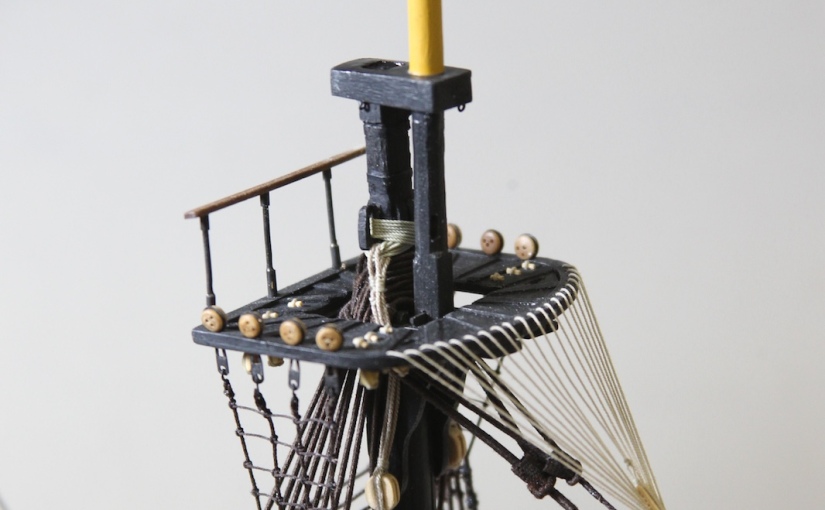


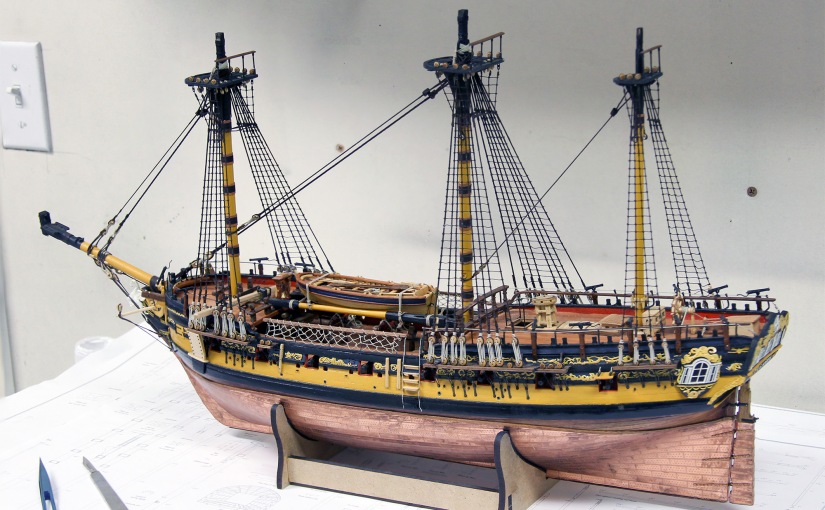


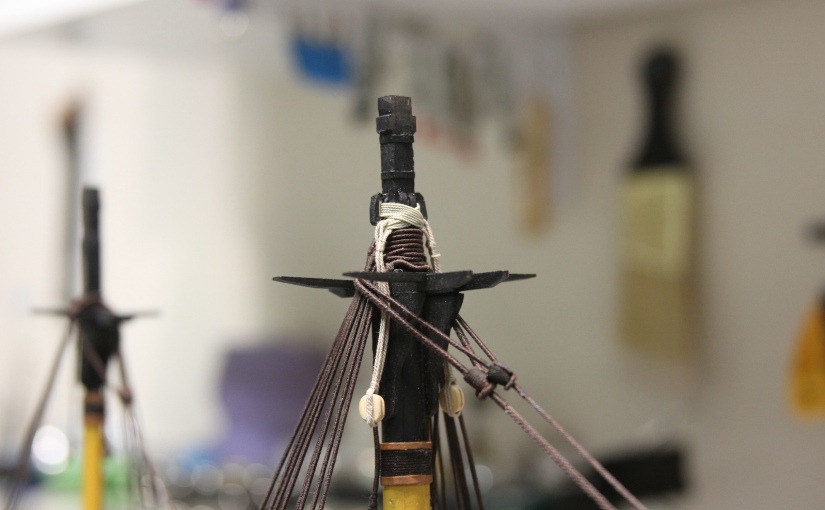


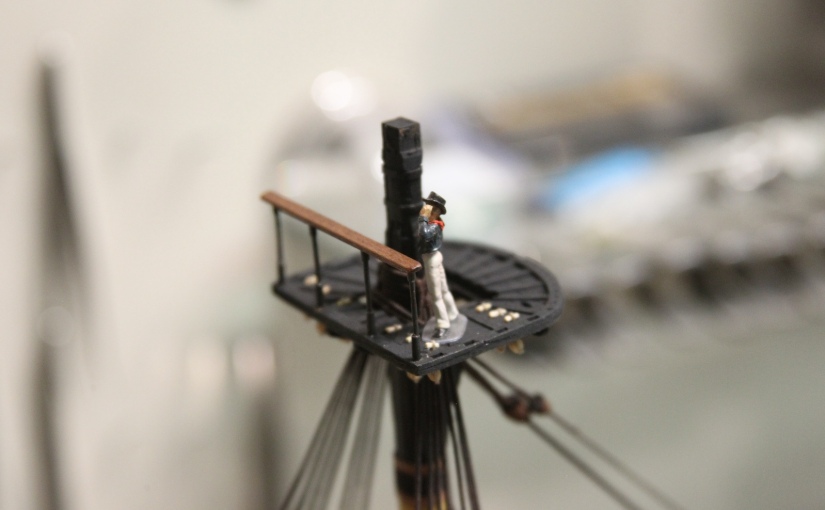


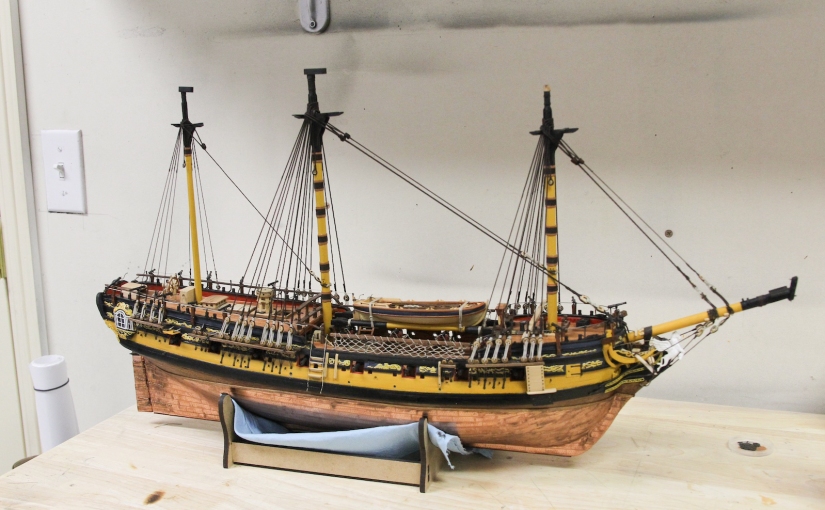


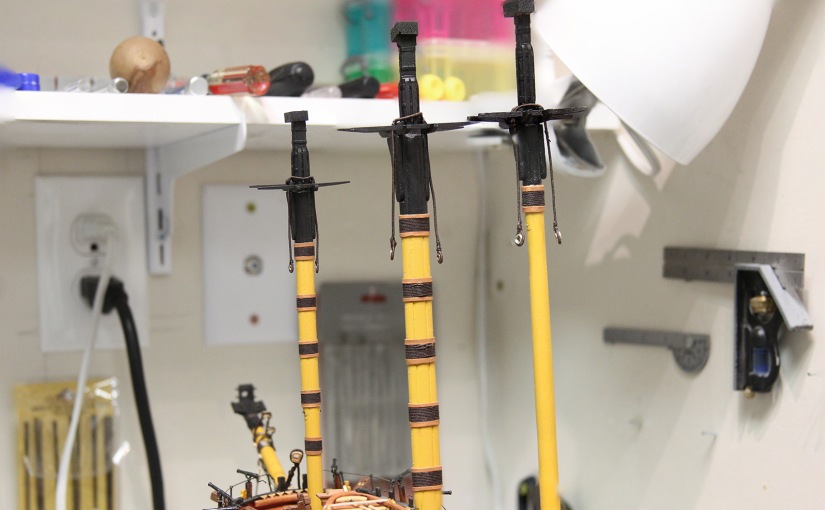


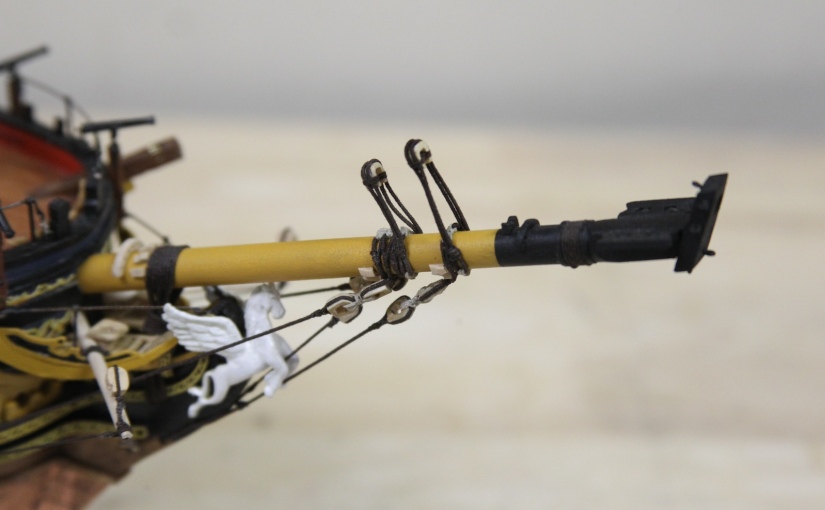


 The Lehman Shipyard